I went to the Tate Modern to see the current exhibition, which pairs Hilma af Klint with Piet Mondrian.

I was quite familiar with af Klint’s work which I like very much, but I didn’t expect much from Mondrian. I think I had seen so many Mondrian knockoffs that I didn’t expect to be interested in his work at all.
Hilma af Klint (1862-1944) was a Swedish artist who is now considered to be one of the pioneers of abstract art. She was a member of the Theosophical Society, a spiritualist movement that was popular in the late 19th and early 20th centuries. Her work was inspired by her belief in a higher spiritual realm, and she often used her paintings to communicate with spirits. She was a good friend of Rudolf Steiner, and had her own group of female group of female spiritualist artists who worked together very intensively.
Af Klint began painting abstract works in the early 1900s, long before Wassily Kandinsky – who has traditionally been considered the ‘founder of abstraction’. Her work was not exhibited much during her lifetime, and it was not until the 1980s that it was rediscovered by the art world. Since then, she has become one of the most celebrated abstract artists of the 20th century.
Af Klint’s work is notable for its bold colours, organic and geometric shapes (most of them referencing sacred geometry), and spiritual themes. Her paintings are often large-scale and highly complex, and they offer a unique perspective on the nature of reality. She was a highly original artist, and her work has had a profound impact on how we now see abstract art.

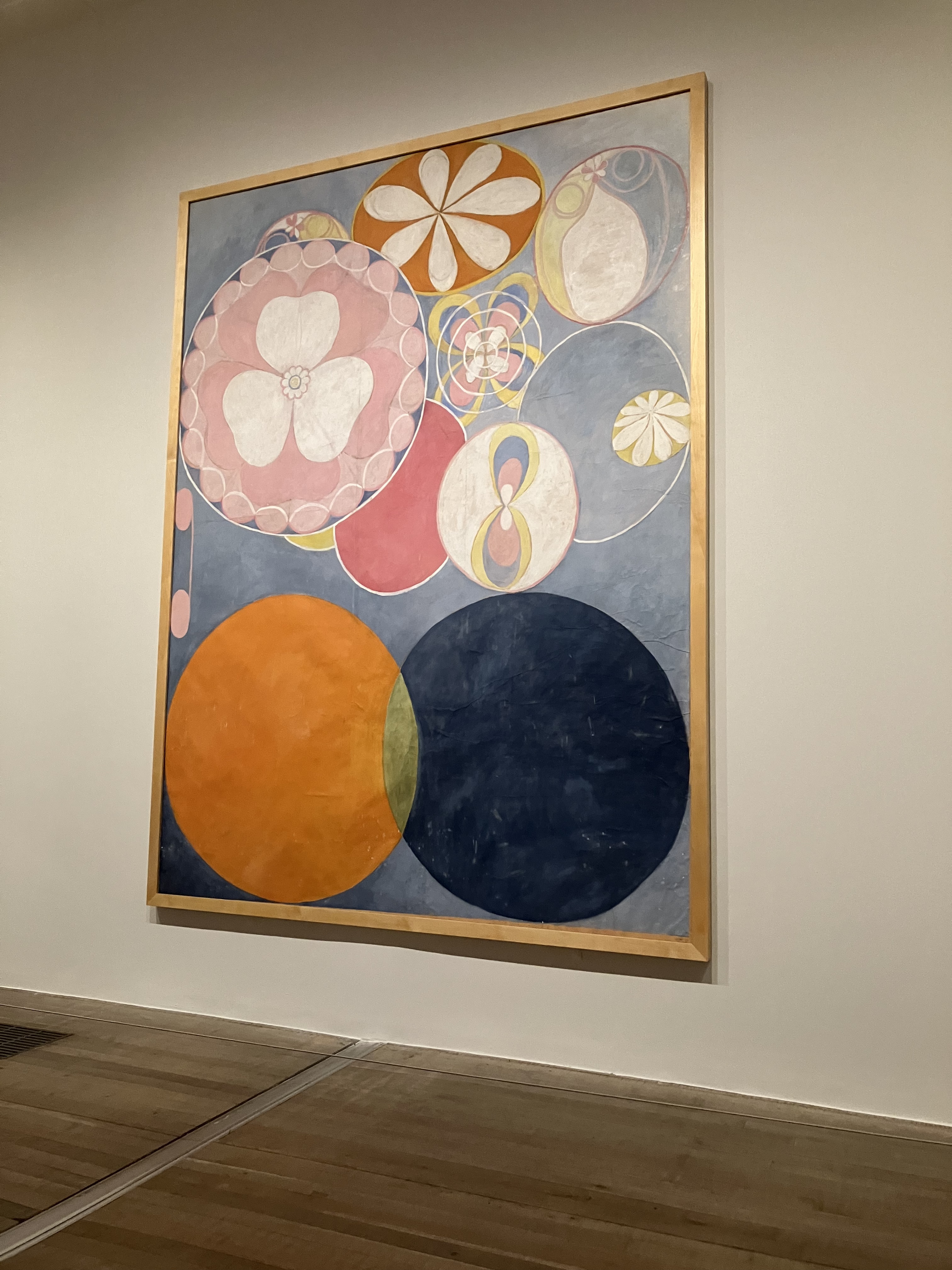


Af Klint was a woman artist working in a male-dominated field, and she faced significant challenges in her career. Her work was inspired by her belief in a higher spiritual realm, and she often used her paintings to communicate with spirits.

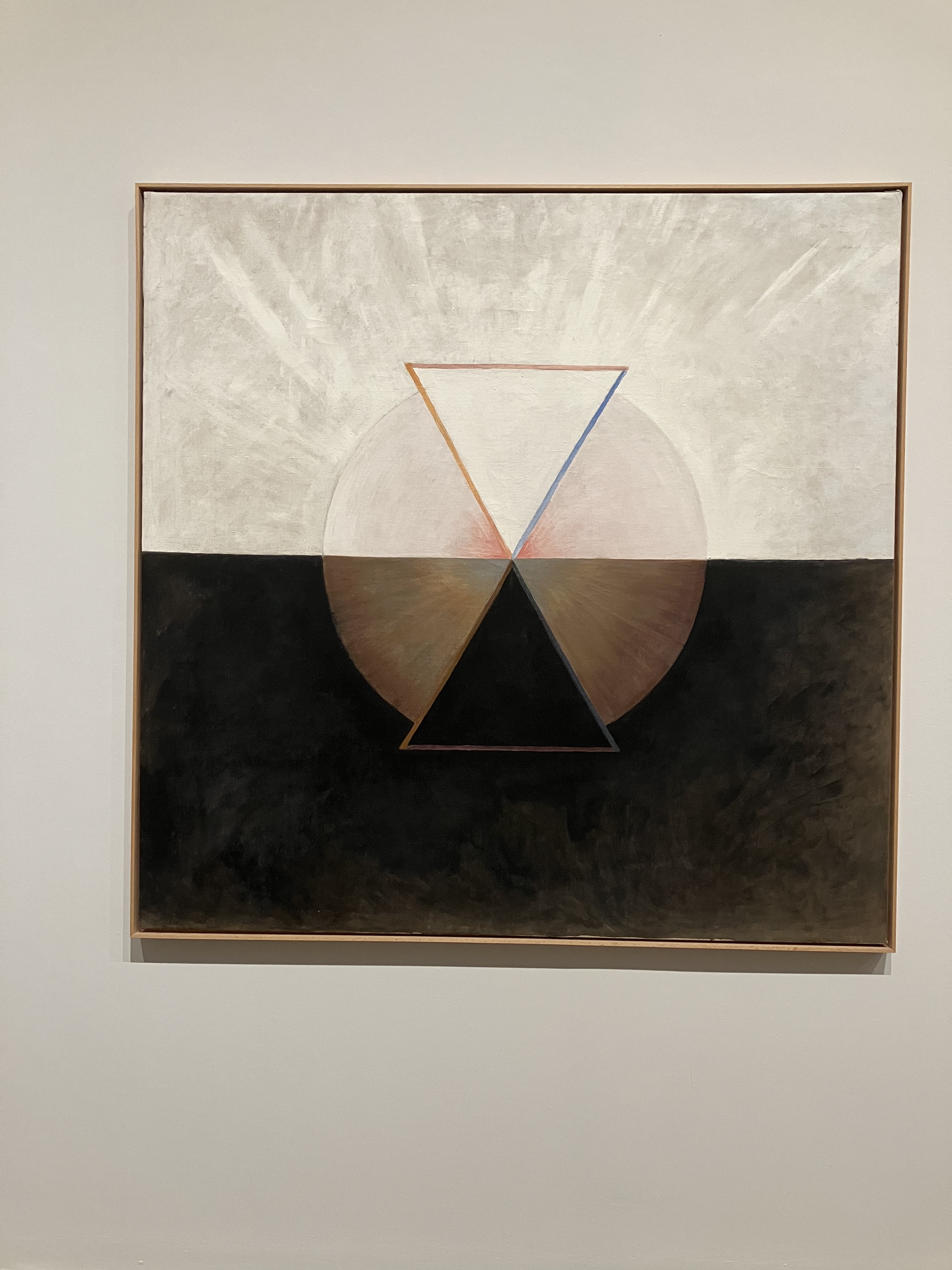

Hilma af Klint is a fascinating and important artist who we are still coming to learn about and appreciate today. She has opened up new vistas in understanding the artistic process and the deeply spiritual path of art. She was a true pioneer, and her work has helped to reshape the art history of abstraction.
But what about Mondrian: did I hate it? Actually, no, I didn’t. I will not pretend that I was as bowled over and inspired by Mondrian’s work as much as by af Klint’s but I enjoyed Mondrian in ways that I had not before.
Piet Mondrian
Piet Mondrian is rightly considered one of the most important artists of the 20th century. His early contribution to the development of abstract art helped to shape abstraction’ centrality to modern art. Mondrian’s paintings are characterized by their use of simple geometric lines and shapes, stark use of primary colors, and black and white. His work is often seen as a representation of the underlying order and harmony of the universe.

Mondrian was born in Amersfoort, Netherlands, in 1872. Studying at the Royal Academy of Art in The Hague, he was exposed to a variety of artistic styles, including Impressionism, Post-Impressionism, and Cubism. In 1909, Mondrian moved to Paris, where he met and befriended other artists who were also interested in abstract art, such as Theo van Doesburg and Gerrit Rietveld. In the early 1920s, Mondrian developed his own unique style of abstract painting, which he called Neo-Plasticism. Neo-Plasticist paintings are characterized by their use of primary colours, geometric shapes, and a grid-like composition. Mondrian believed that these elements could be used to create a visual representation of the universal harmony that he believed existed in nature. In 1917, Mondrian co-founded the De Stijl ( the Style) movement, which was dedicated to creating a new, ‘universal’ style of art that would express the underlying unity. The Tate show has a good range of examples from Mondrian’s early works.

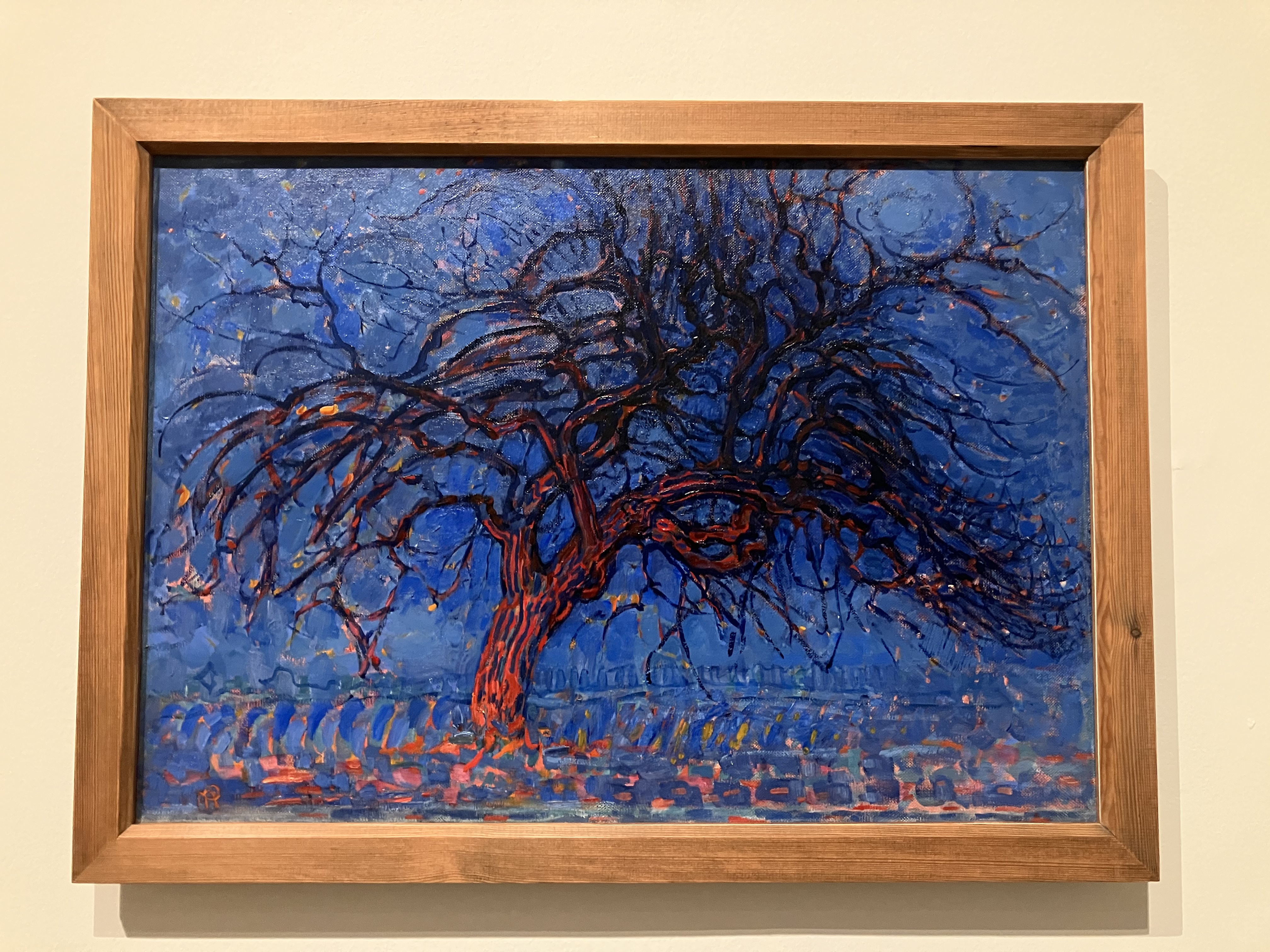
What I didn’t know before was that, like Wassily Kandinsky (who wrote ‘Concerning the Spiritual in Art’ in 1910), Mondrian was also deeply involved in spiritualism; it was one of the driving forces of his artistic practice and world view.
Mondrian believed that art could be used to express the underlying unity of the universe, and his paintings are the visual representations of this belief. Mondrian’s spiritualism also influenced his choice of colours, shapes, and compositions. He believed that primary colours were the most pure and expressive colours, and that geometric shapes were the most basic and universal forms. He also believed that a grid-like composition represented and even invoked order and harmony.
He sought to reduce the elements of the world to simple geometric shapes and primary colours – a technique both bold and visually striking. This is how he saw the underlying order and harmony of the universe. Fascinatingly, as the exhibition demonstrates, Mondrian’s work was constantly evolving, as he experimented with different styles and techniques throughout his career.
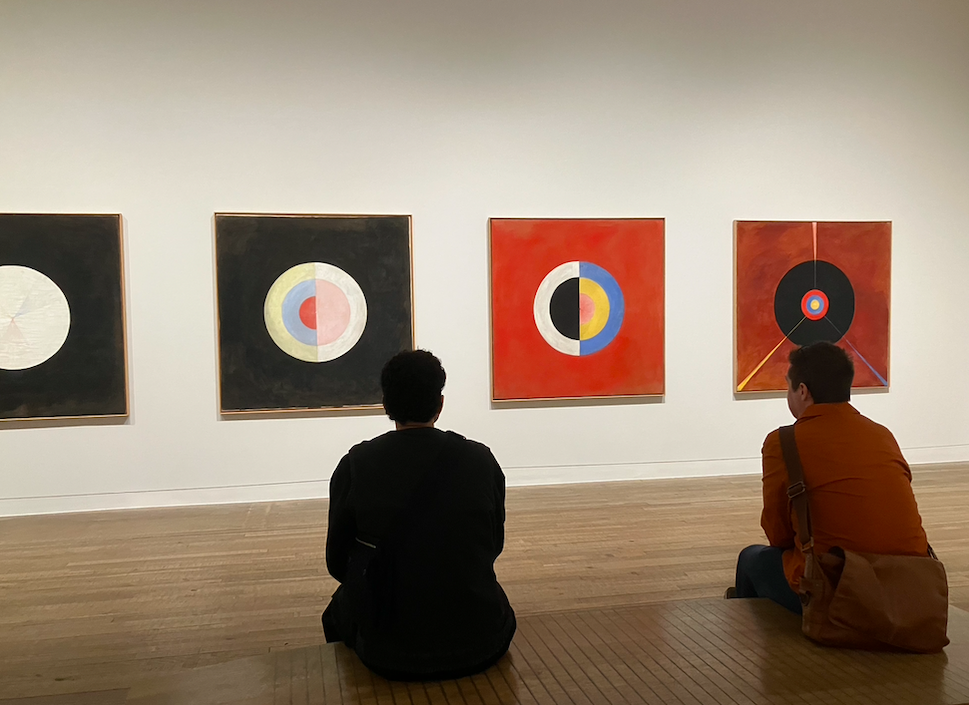
I left the exhibition with a renewed appreciation for Piet Mondrian although the spiritual experience I had was definitely the gift of Hilma af Klint. Her work is so immersive, so totalizing, so overwhelming and so evocative that I left a different person from when I went into the Tate Modern. Her colours stayed with me through the rest of the day, wrapping me in a sensation of the gorgeousness of all nature.
 THE ART TRAVELLER
You must be logged in to post a comment.