The Wellcome Collection’s new show explores ‘beauty myths’ past and present

It’s Black Friday yet again and my social media feeds and my e-mail inboxes are deluged with ads for Black Friday sales, and I notice that many of them are sales of luxury cosmetic items. Oh yes, I see the appeal. I am not immune to the lure of a really good lipstick and eyeliner that promises Cleopatra-like allure, or a scent that will enchant everybody within nose-range. Truly, the cult of beauty is alive and well, as it has always been.
One of the first things we did as human beings is decorate the body. We know this because archaeologists have dug up many burial sites and found the remains of people who have been buried with their bodies smeared with pigments, usually earth ochres, reds, and yellows. In many cases, they have been tattooed as well. This early attempt at cosmetics marks out the burial practices of the human species because we see these burial practices as early as 48,000 BC in all parts of the world!
As well as decorating the body in death with pregnants it seems that we decorated them in life as well Obviously we don’t have any photographs or even paintings of people from the distant past to know what they look like with pigments applied to their faces and bodies, but by the time we come to ancient Mesopotamia and ancient Egypt we do know because they left great pictorial records of how they used cosmetics. This is mostly seen in the relics of ancient Egypt, where we know that since 3000 BC they used kohl – an ancient eye cosmetic, traditionally made by grinding stibnite or galena. Kohl was originally used to protect the eyes: the thick black liner protected the eye from the fierce sun of the region and eye infections. Later formulations were made from ground malachite to create a green liner and frankincense ash was also used.

The Wellcome Collection’s new show acknowledges the contribution that Egypt made to the history of cosmetics by featuring a replica of the famed Nefertiti bust at the entrance of the exhibition THE CULT OF BEAUTY. Inside the comprehensive exhibition, we find all kinds of explorations of the cosmetic- from historical recipes for renaissance skin products to contemporary questioning of beauty ideals and the role of the cosmetics industry.

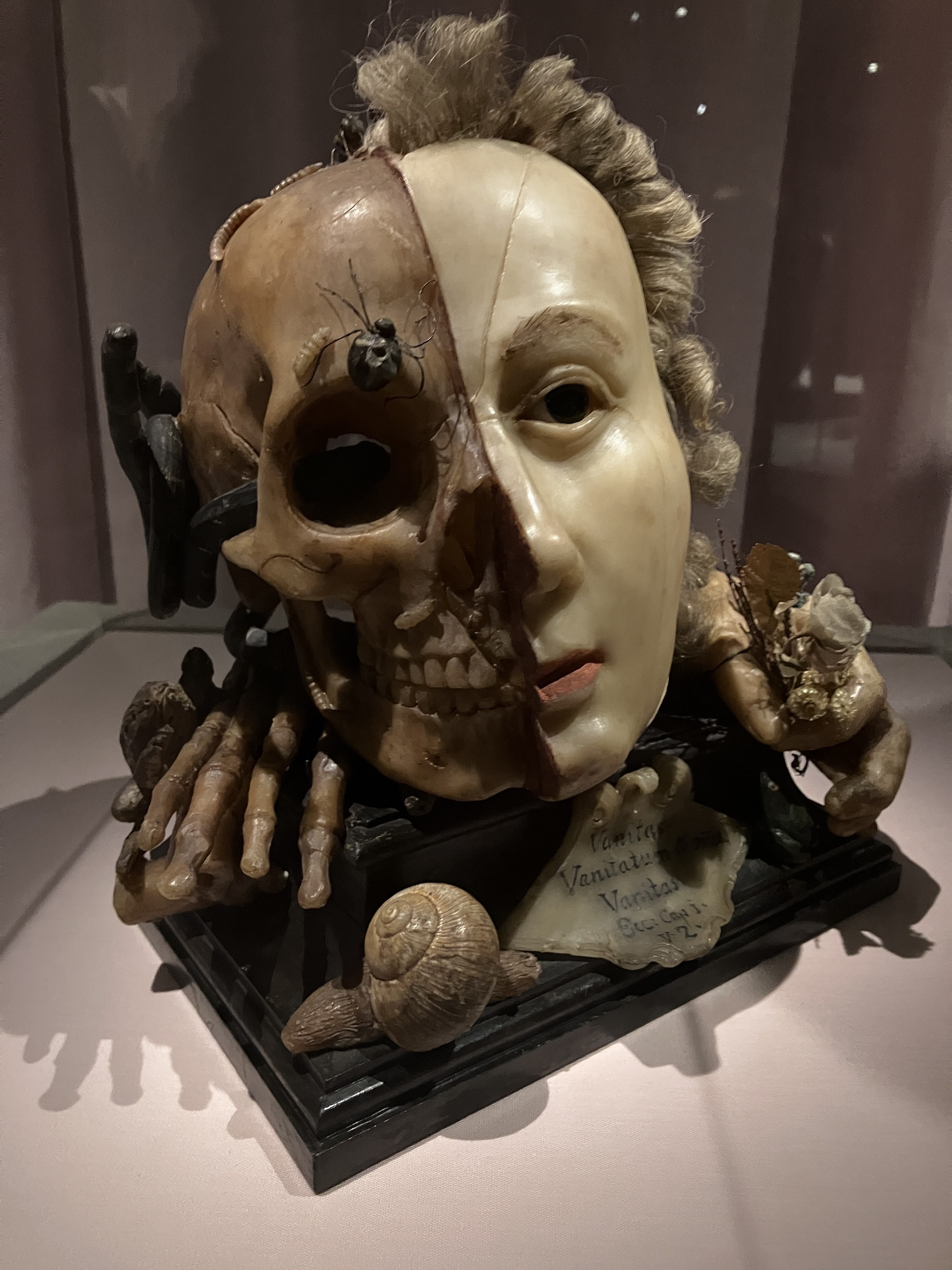
We’re immediately reminded of the charge of “vanity” that beautification incurs – despite beautification being as natural to the human as breathing! The stunning Vanitas sculpture from the Museum’s own collection greets the visitor, a grinning skull peeps out from a smooth, living face. This wax grotesque is satisfyingly creepy, spiders and all.
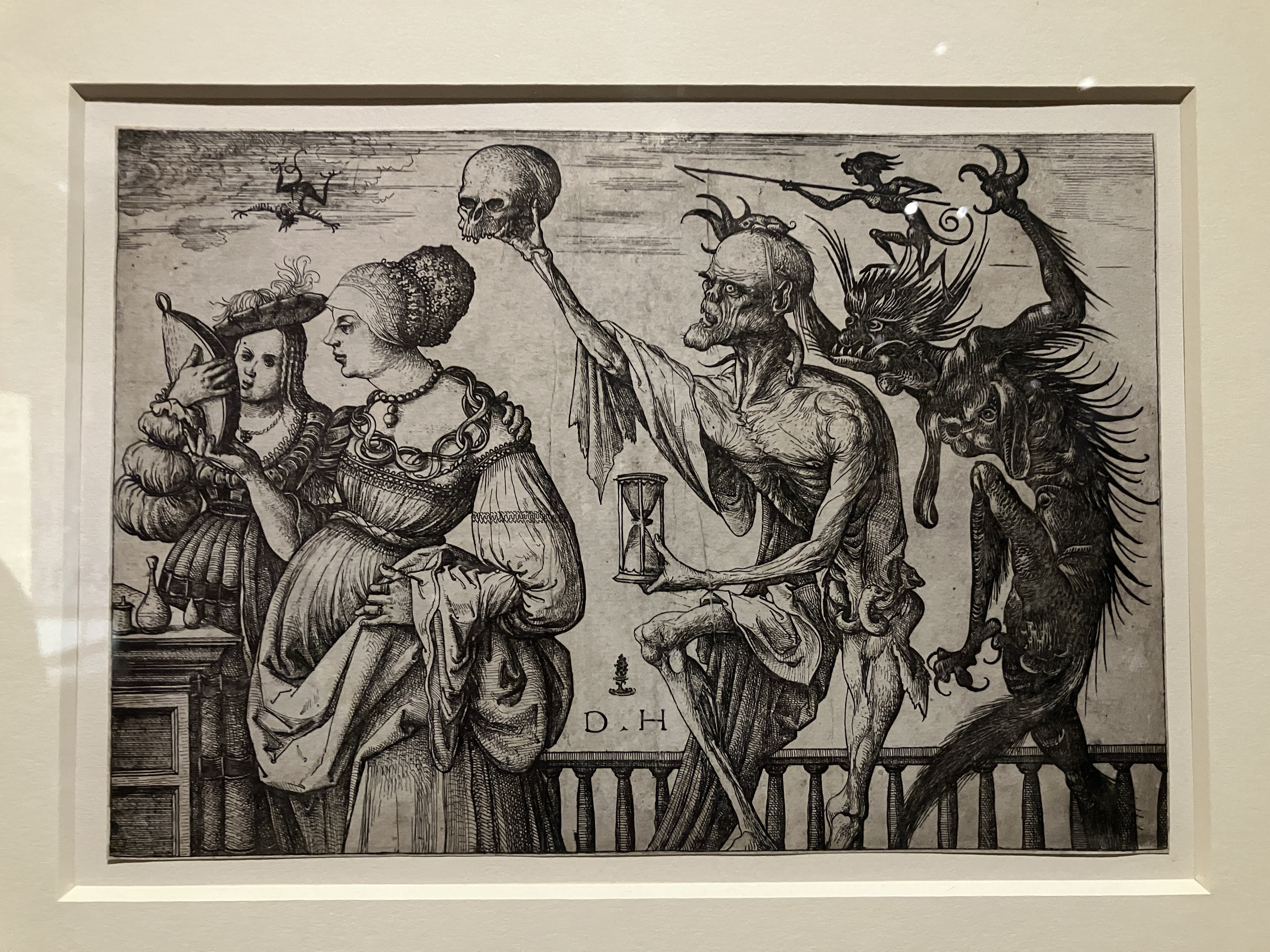
The Devil is evoked to warn women (always women!) against vanity in this print. She’s not paying any attention and rightly so! There’s quite a lot of misogyny in some of the imprecations against vanity. For example the exhibition features a c. 1650 engraving by Paulus Fürst of “Husbands bringing their ugly wives to a windmill, to be transformed into beautiful women”. The husbands aren’t at all attractive.
A more pointed caution against vanity is offered in this cartoon from the 18th century, which questions why people (in this case, a man) wear such body-disfiguring undergarments. Good question.

This image is pretty funny, but less amusing is the nearby example of a metal corset from the 1800s.
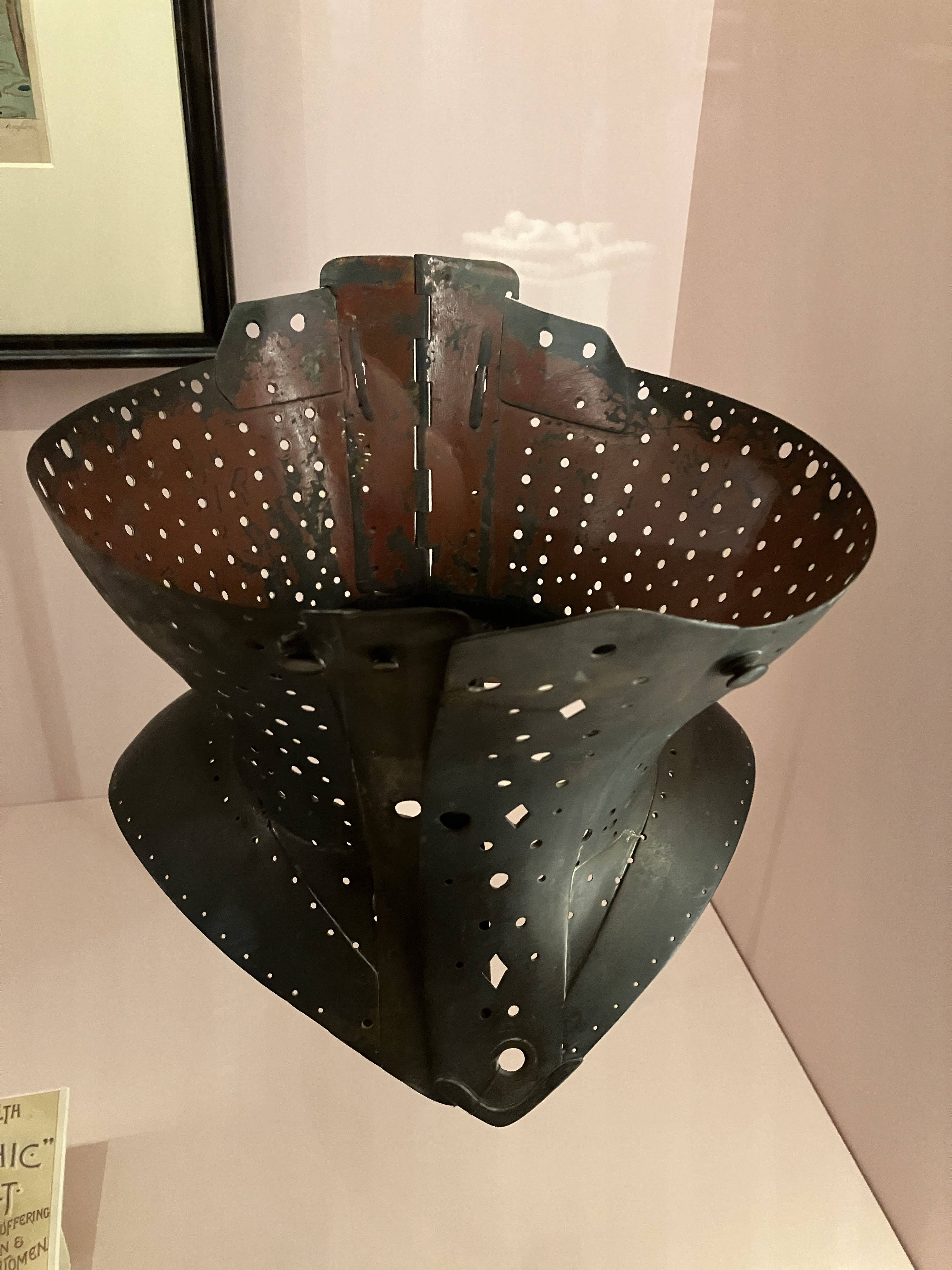
The caption says that this is an “Orthopaedic corset for bone or muscle realignment” which may be its intention, but the shape and size of the waist surely denotes some kind of grotesque “ideal” figure that was desired at the time. Pity the poor creatures who were made to wear it. Of the corset craze, the exhibition says that
“Research in the late 18th century argued that overly tight corsets could be harmful, but they continued to be fashion staples, often accentuating a tightly cinched waist. Supportive bodices or ‘stays’ with purported health and comfort benefits also gained popularity in the late Victorian period. Electropathic belts were marketed as running a stimulating current through the wearer. Similar questionable claims promoted maternity corsets and stiffened bodices for infants.”
The exhibition touches on the idea of “racialisation” in beauty standards, something well worth discussing though it is not given enough space in what is admittedly an already huge exhibition. It does however address the complexity and complication of making a too-easy judgement. We are familiar with the idea that “light skin is more beautiful than dark skin” is a consequence of colonisation and racist Western beauty norms. But that is not the whole story – the exhibition gives the example of pearl powder skin lightening from a Chinese medicinal book complicates this history. Published in 1591, it predates the introduction of Western notions of race. Similar powders were used in Japan and “fine white” skin was prized in India as a signal of upper-class beauty long before European encroachments. Still, it is true that in the 20th century fashion and beauty industry, women of colour were pressured to aspire to the impossible and unattainable standard of Anglo Saxon beauty: long blonde hair and white skin – soon to be changed to long blonde hair and bronzed St Tropez skin after WWII. These notions are still active today – look at Beyonce, lovely as she is. Of course, people are entitled to have their hair how they like and wear what they want. But it is unsettling, sometimes how the same beauty tropes reappear over and over.

My personal highlight. of the show was the Ripley Scroll. Named after the English alchemist George Ripley (d. 1490), this is a 17th-century reproduction of a 15th-century scroll. Here the process of alchemy is presented as an ancient, secret science improving upon nature by transforming crude prime matter (in the form of a toad) into a subtle elixir (the dragon’s blood). This substance can turn base metals into valuable silver and gold and prolong human life. The intricate beauty of the scroll’s design translates obscure laboratory practices into an explanation of alchemy’s transformative power. This idea was very influential and many alchemists sought the Philosopher’s Stone not only for its properties in turning base metals to gold but also to rejuvenate life. Cagliostro the 18th century alchenist and mage had a mysterious elixir with which he claimed he could bring rejuvenation – and many charlatans and snake oil salesmen up to the present day are still in this game. “Turn Back Time!’ “Wrinkle Eraser” – you name it!
A fun part of the show is the Renaissance cosmetics lab, the “Beauty Sensorium” a beautiful installation of a mockup of the lab making the old recipes.
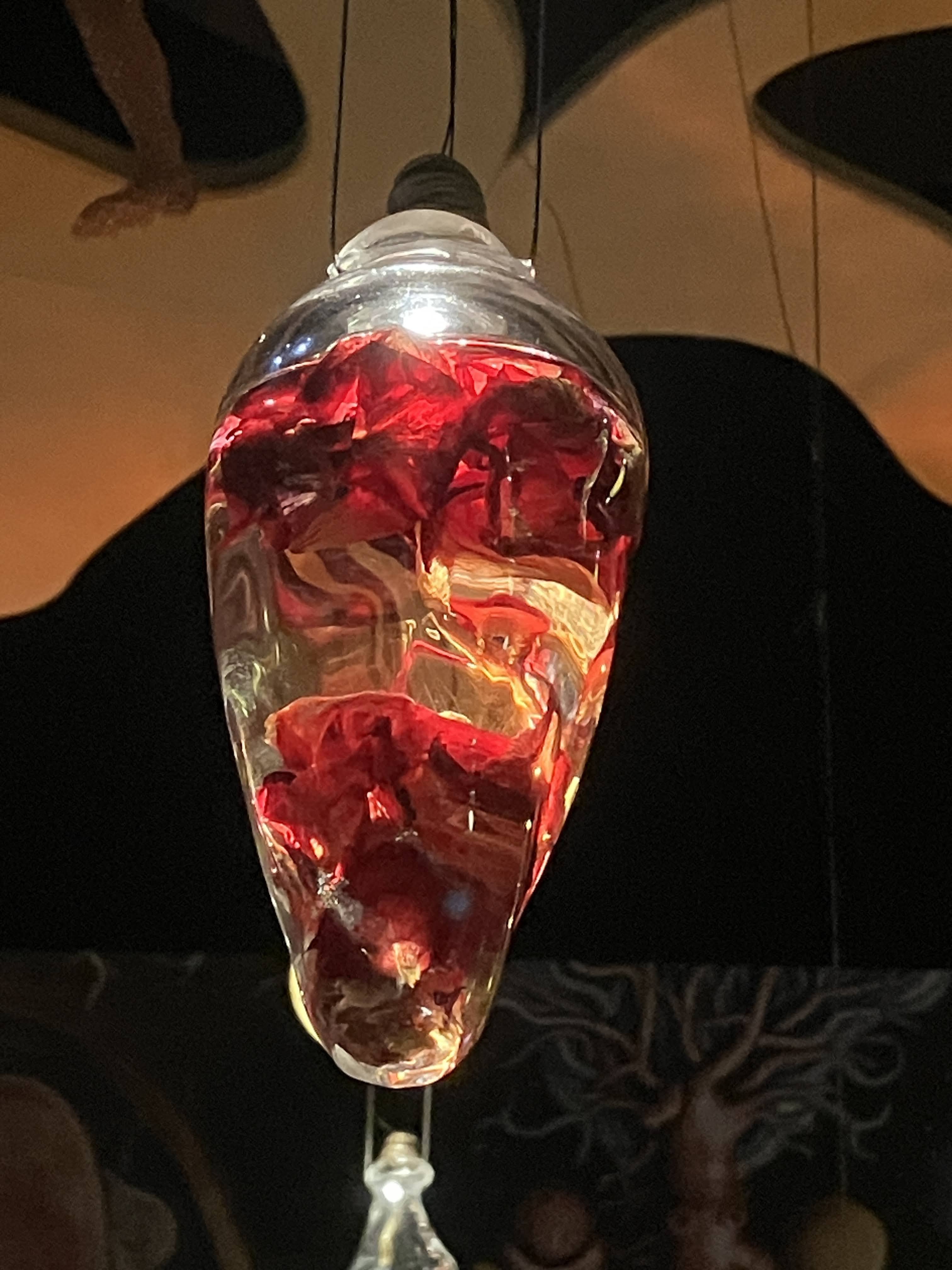
As the exhibition explains:
“Beauty Sensorium features five ‘Renaissance Goos’ – reconstructed cosmetic recipes from a 1562 Italian text, The Ornaments of Women. This type of products was often made by Jewish women immigrants following the Expulsion of the Jews from Spain in 1492. Renaissance apothecaries organised vessels and recipe manuals in a similar way to contemporary soft matter scientists, according to their fluid properties. The women who made cosmetics at home had a sophisticated understanding of how to exploit the tactile properties of natural materials. This project highlights the historically overlooked role women played as pioneering chemists and botanists.”

The exhibition is huge and I have barely covered it here! In fact, I barely took it all in and so I will have to go back. Fortunately, it is open until April 2024 so there is plenty of time. And it is Free! I highly recommend the show. It offers up much food for thought. How trapped are we in beauty ideals? Why does buying fancy lipstick feel so good? Are we just slaves to the cosmetic industry, or are we re-enacting a rite that goes back 50,000 years?
THE CULT OF BEAUTY, THE WELLCOME COLLECTION – FREE – TIL APRIL 2024 https://wellcomecollection.org/exhibitions/ZJ1zCxAAACMAczPA
 THE ART TRAVELLER
You must be logged in to post a comment.