Hiroshige
artist of the open road
For many outside Japan, the country’s landscape first appears not in person, but on paper—through the flowing lines and rich colors of ukiyo-e prints. Hiroshige’s evocative views of coastlines, mountains, and small towns invite us into a world of both realism and reverie.
The Japanese landscape, as seen through the art of Hiroshige and other ukiyo-e masters, is more than scenery—it’s storytelling. Each print combines craft, imagination, and cultural spirit, creating a dreamlike vision of nature and everyday life in Edo-era Japan.
I am overwhelmed by the beauty of the landscape of Japan. In my imagination, it it has a dreamlike quality with ineffable delicacy. It seems to be a series of images that one can fall into and float around in. But I’ve never been to Japan, and I realised that this notion I have of the Japanese landscape comes mainly from my love and appreciation for ukiyo-e, or Japanese woodblock prints by Hokusai, Hiroshige, and Kobayashi Kiyochika (among many others).. Hiroshige in particular was best known for his glorious depictions of the Japanese countryside and little towns. He drew some of the pictures from life, while others sprang from his imagination based on stories he heard from travellers.
In this exhibition, we see how Hiroshige made several arduous and fascinating journeys between Japan’s 2 capitals, Edo (now Tokyo) and Kyoto. In his print series he depicts both: the coastal route and the arduous mountain route. His drawings were carved into wood blocks and printed as colour separations. The exhibition did an excellent job explaining exactly how these woodblock prints were made,. They were complex and difficult. Not only did the drawing have to be precise, but it also needed to be replicable onto numerous different blocks of wood so that all could be lined up and accurately have colour applied. (People who do screen painting know how the process works).

Carving wooden blocks to do many colour separations must be extremely difficult. Mastering this craft really is something impressive. These Ukiyo-e were not solo endeavours.Although the work is attributed to Hiroshige, it actually started with him as a drawing, Woodcarving was done by another artisan, and printing done by still another – all under the supervision of Hiroshige. , Ukiyo-e were not paintings: they were mass market products. Hiroshige made many drawings to be printed on paper fans which were very popular.

The exhibition also displays a number of his original drawings and paintings, alongside his sketch books. It’s important to be able to see the breadth of his talent and the different kinds of outputs. While he made most of his work for prints he was an amazing painter, and he did have collectors who bought his paintings

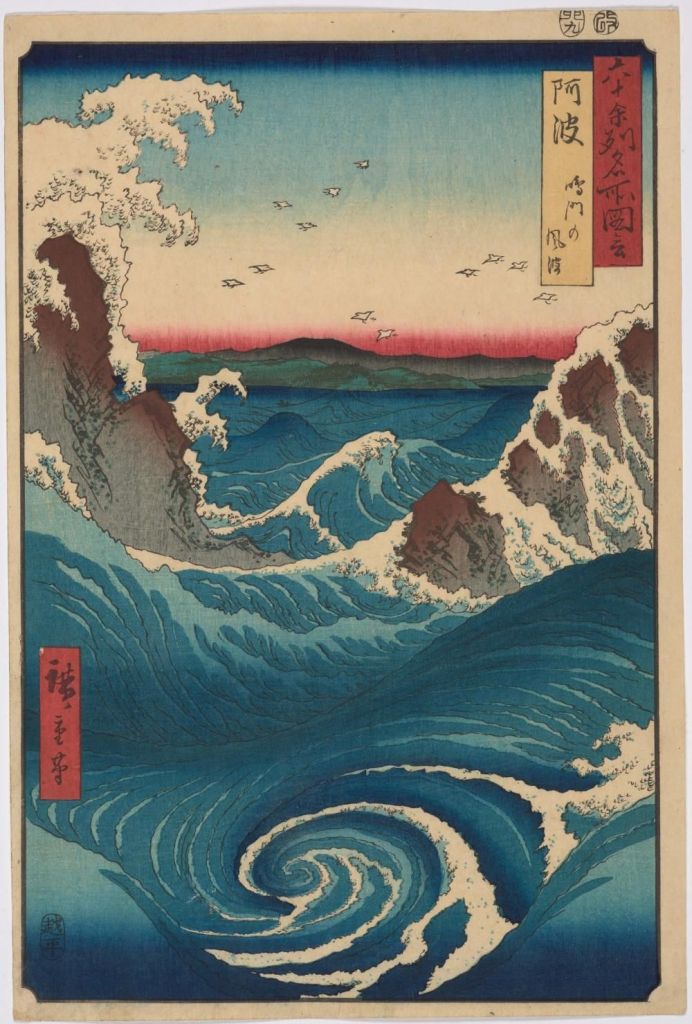
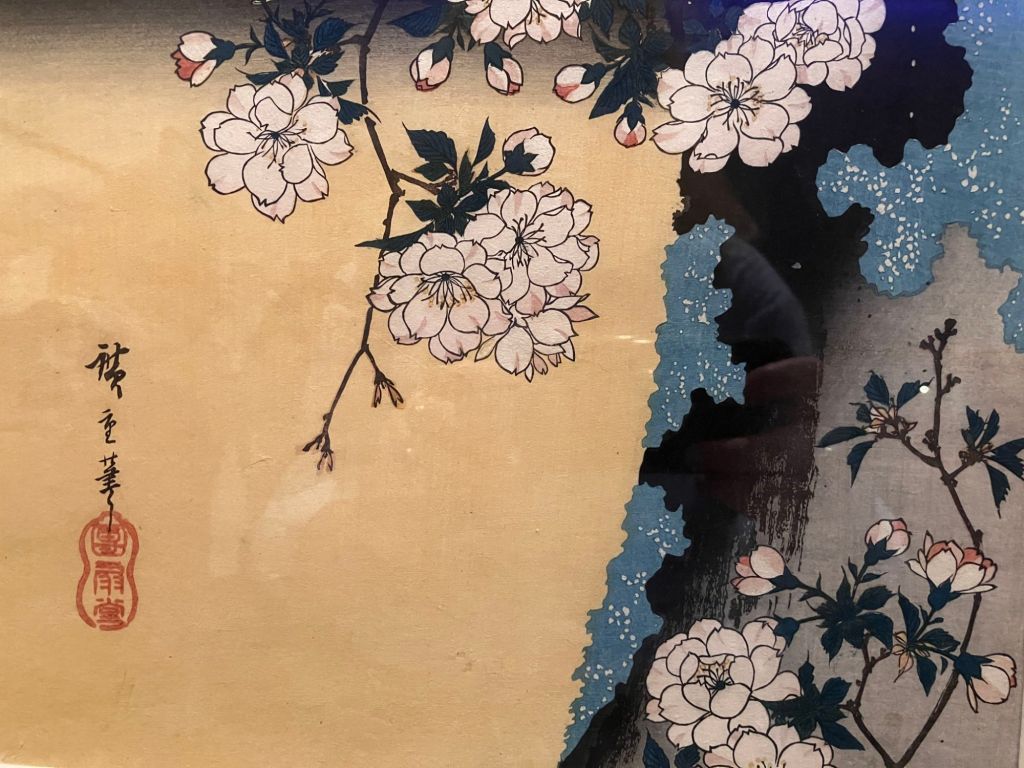
Though probably best known for landscapes such as Awa: The Rough Seas at Naruto from Illustrated Guide to Famous Places in the 60-odd Provinces, he also did wonderful depictions of Japanese society and and ordinary things like people enjoying a day out on a pleasure-boat, womem visiting a shrine in the snow, and a wonderful parade of samurai women (an unusual subhect).. He depicts people caught in a rainstorm, among other situations. Hiroshige mixes the sublim e with the everyday. Sometimes nature provides drama- weather, sea and mountains overwhelm and make one gasp. At other times a single falling cherry blossom conjures quie t, sweet melancholy. Hiroshige’s work is realistic but not realist – he draws what he sees, but he seeks to give his viewer pleasure. This is especially true of his drawings of nature and animals.

“Hiroshige travelled widely and in the preface to his last illustrated book, One Hundred Views of Fuji (posthumously published in 1859), explains that his drawings present ‘views that I had before my very eyes and took down exactly as I saw them’ and that while ‘abridged in many places, they show entirely true-to-life landscapes, in order to give others a few1 moments of pleasure without the inconvenience of a long journey’. Notes in his surviving travel picture-diaries oni all-night drinking parties, the quiet refinement of an unadorned home in the provinces and remarkable people, such as a samurai-swordsman who demonstrated how to draw a longsword from a seated position, show Hiroshige to have been sociable, interested in the world around him and open to the small adventures that travel sometimes affords. They indicate that even when not based on direct experience or literal fact, his landscape views were rooted in a true and sympathetic understanding of the land and of life on the open road.”
- Alfred Haft, JTI Project Curator for Japanese Collections
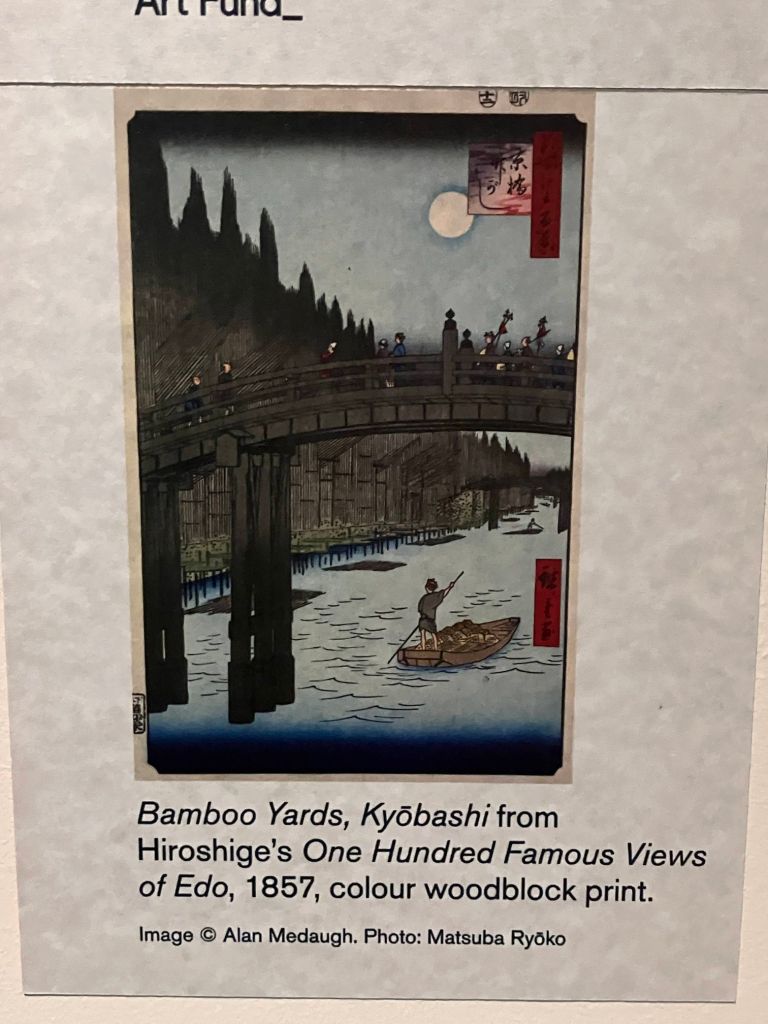
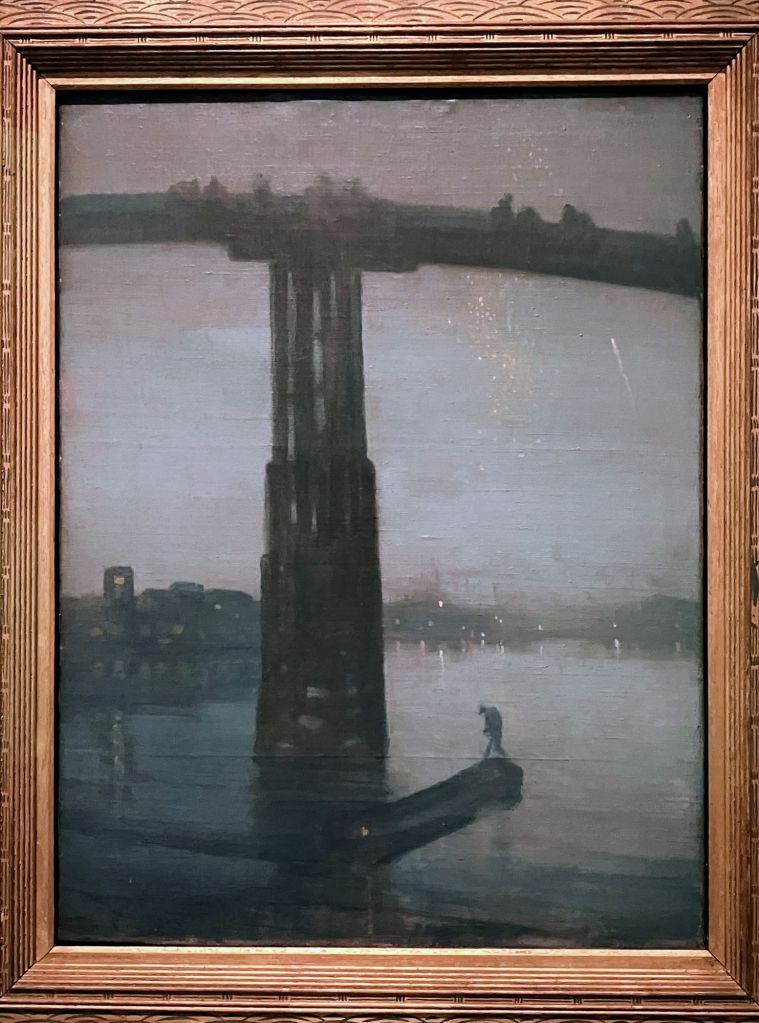
1I am certainly fortunate that I managed to see this show just before it closed. I wasn’t the only one. It was very busy and people were really spending a lot of time in front of each picture, giving it the attention it deserved. It is the first exhibition of the artist The British Museum has done in many years. It’s wonderful to see that there appears to be a new appreciation of ukiyo-e, that beautiful and highly influential art form. The exhibition closes with a small selection of artworks influenced by Hiroshige, including one of my favourite paintings of the late nineteenth century: James McNeill Whistler’s Nocturne: Blue and Gold – Old Battersea Bridge (1872).
Read more
 THE ART TRAVELLER
You must be logged in to post a comment.