My mini-tour of the Wallace Collection’s standout paintings and objets d’art.
Tucked behind the shopping paradise (or Hell) that is Oxford St, you’ll find the quiet magnificence of the Wallace Collection. One of the wonders of London, the private collection of Sir Richard Wallace and the first four Marquesses of Hertford, is housed in Hertford House on Manchester Square in Marylebone. Following Lady Wallace’s 1897 bequest, the collection was housed in the former townhouse, which was transformed into a museum in 1900. Instead of seeming like a neutral gallery exhibit, the displays are designed to represent the lifestyles and tastes of the founders, retaining the atmosphere of a big domestic room. Influenced by London society and the 4th Marquess’s lengthy stay in Paris, its provenance and setting tell a unique narrative of aristocratic collecting across the 18th and 19th centuries.
Sèvres porcelain, gilt bronzes, and Louis XV-Louis XVI furniture are on display alongside masterworks like Frans Hals’s The Laughing Cavalier and Fragonard’s The Swing, as part of the museum’s renowned collection of eighteenth-century French paintings and decorative arts. From the fourteenth to the nineteenth century, it houses works by Old Master artists, including Titian, Velázquez, Rubens, Van Dyck, Rembrandt, Boucher, Watteau, and Gainsborough. There are also impressive works of art from the Middle Ages and the Renaissance, including Limoges enamels, maiolica from Italy, glass, and bronzes. There is a collection of armour and weapons from both Europe and other parts of the world. Interspersed with paintings, furniture, and china, the gorgeously decorated period rooms create an intimate, cabinet-like atmosphere that highlights decorative harmony and connoisseurship.
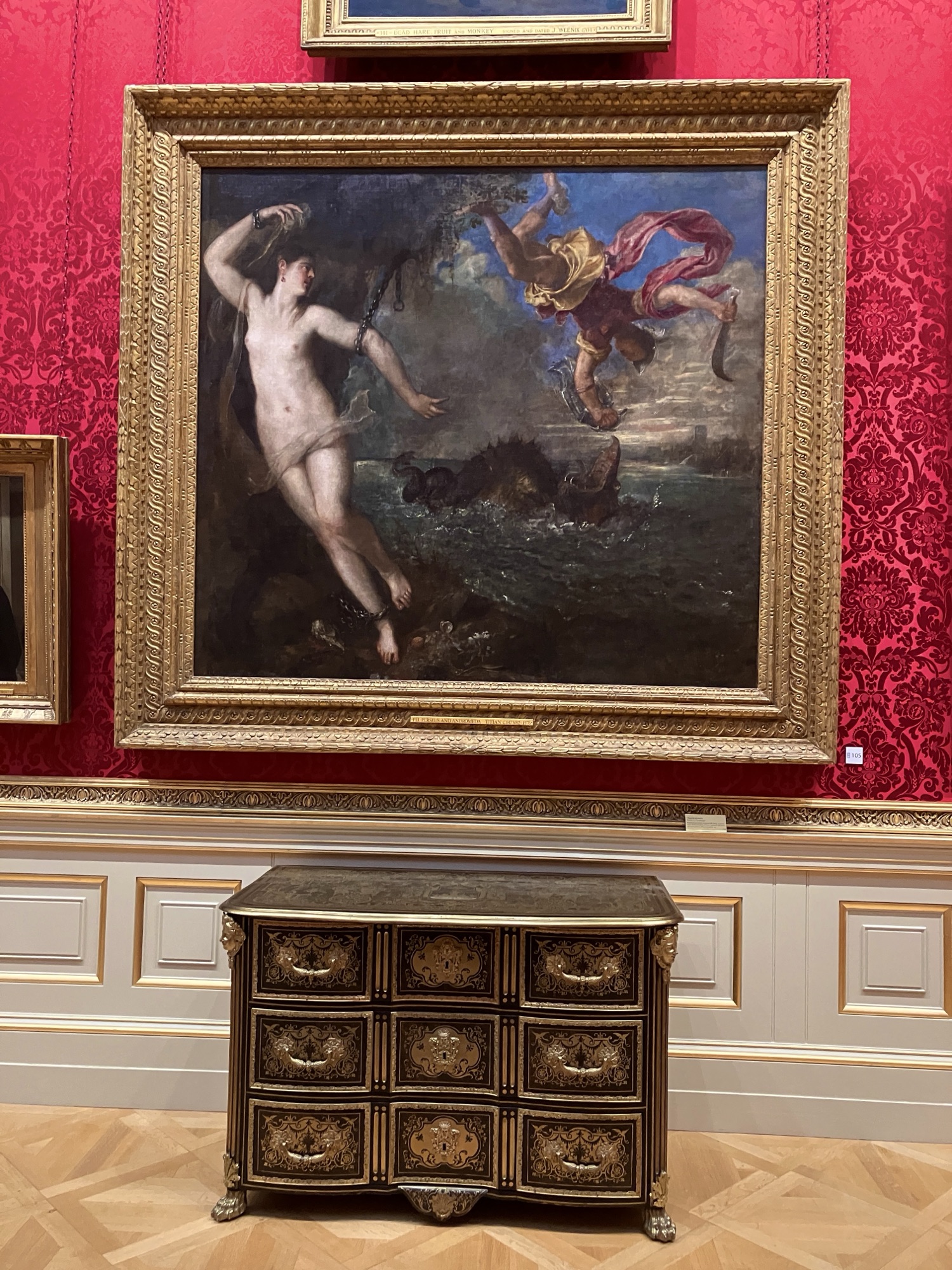
A masterpiece in painting motion and the pregnant moment, Titian’s Perseus leaps into the dark, roiling sea, ready to fight the dreadful monster. Andromeda, captive and terrified, looks on. Titian’s colours are bright and beautiful and the pale gleam of Andromeda’s body stands out showing her vulnerability.
According to Greek Myth, Andromeda was actually an Ethiopian princess, so really Titian’s lady is the wrong colour, but he was simply following the Eurocentric tradition. The story is rather horrid: Andromeda is the daughter of Cepheus, King of Ethiopia, and Queen Cassiopeia. When Cassiopeia claims to be more beautiful than the Nereids, Poseidon unleashes the sea monster Cetus to wreck Ethiopia’s coast as divine punishment. The ultimate toxic mother, Queen Cassiopeia believes that chaining Andromeda to a rock as a human sacrifice will satisfy Poseidon. Perseus discovers her when he returns from his quest to decapitate Medusa. Perseus attacks the Cetus the Monster, and petrifies him with Medusa’s head. Having saved Andromeda, Perseus carries her back to Greece to marry her and rule as his queen.


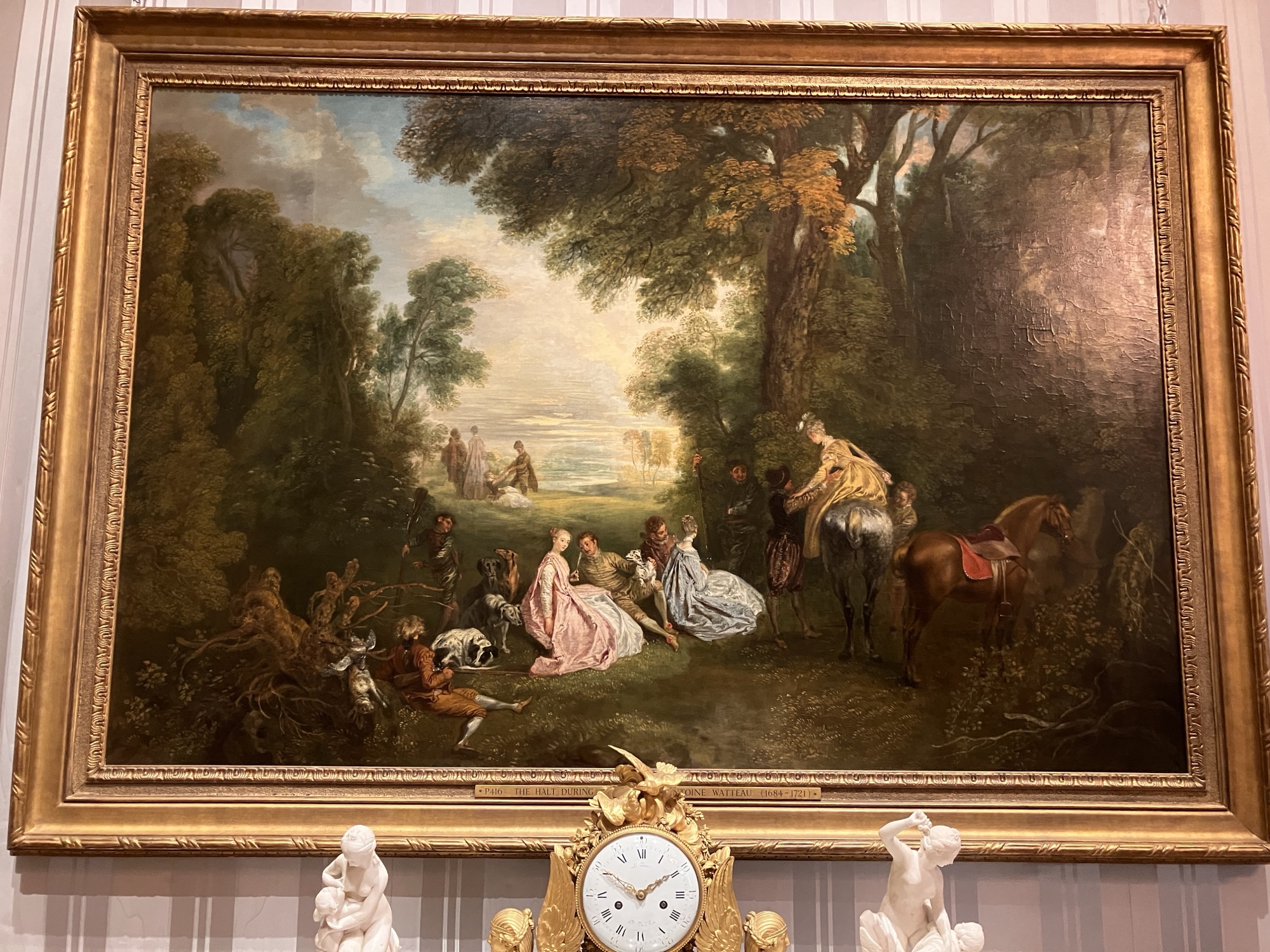
Let me be serious for a moment and look into this painting, which is another of my favourites. I’ve been fascinated by Watteau for a long time.
Rendez-vous at the hunt (painted 1717-18 so late in Watteau’s life) is typical of Jean-Antoine Watteau’s ‘fêtes champêtres’ (outdoor party, is the best translation I can come up with) paintings which express both joyous good times and a touch of melancholy. These leafy idylls are staged as fleeting interludes, poised at the moment when pleasure is already shading into loss. The music, flirtation, and silvery daylight that bathe these gatherings signal ephemerality—light fades, and parties disperse—so the pastoral setting becomes a theatre of passing time rather than a realm of timeless ease. Figures rarely lock into secure embraces; they hesitate, glance away, or drift toward the edges of the grove, their errant gestures and uneven groupings suggesting desire that is unfulfilled or already dissolving. Motifs intensify this elegy: we see a hint of autumnal foliage and late-afternoon light – tuning the eye to transience. Far away, bathed in light, the world is immaterial, watery. In this suspended, theatrical world, delight is inseparable from disenchantment, so the fête becomes a reverie haunted by time—beautiful precisely because it cannot last.


Hertford House
Manchester Square
London
W1U 3BN
United Kingdom
open daily from 10.00–17.00
Entry to the permanent collection is free
More Art Travel tips about the Wallace: it’s big but manageable and there are many places to sit and contemplate the art. There’s a beautiful cafe in the inner courtyard, but also lots. of other choices in the area for coffee, food or drinks.
 THE ART TRAVELLER
You must be logged in to post a comment.