Ben Edge’s THE CHILDREN OF ALBION at the Fitzrovia Chapel
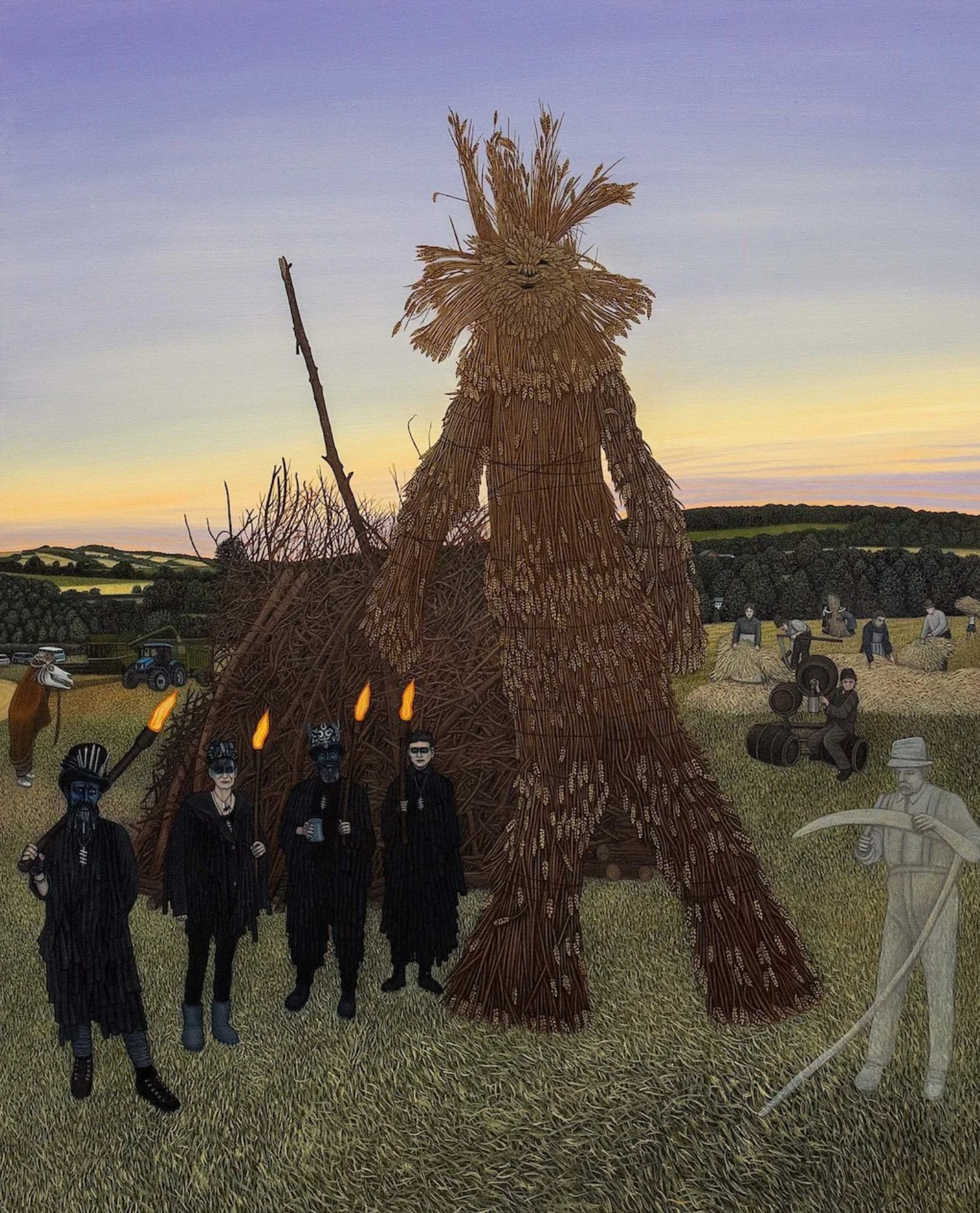
Artist Ben Edge has spent a considerable time wandering the British Isles, exploring folk culture, folk magic, and folk ritual. Of course, folk culture and folk ritual have never entirely disappeared, but they certainly seem to be experiencing what Edge has called a “folk Renaissance.” Edge has observed an increasing desire among people in these islands to discover and reclaim their ancestral roots and — most notably — to reconnect with nature.
But as the exhibition programme points out, it is not about indulging in nostalgia. Instead, it’s about reclaiming something that was always ours but which we lost sight of, and it’s also about looking forward to reclaiming our right to the land and our indivisible relationship with nature. It’s about reimagining a shared cultural identity that is not about race, but about feeling—about recognition and respect for the marginal and liminal practices, beliefs, and celebrations that predate and, in some cases, defy the world of global capitalism.
Exploring ancient sites such as standing stones and archaic rituals re-enacted by new generations, Edge recovers folklore in which demons and devils (often quite mischievous) caper, superstitions are revisited, and storytelling is restored to its role in the community.

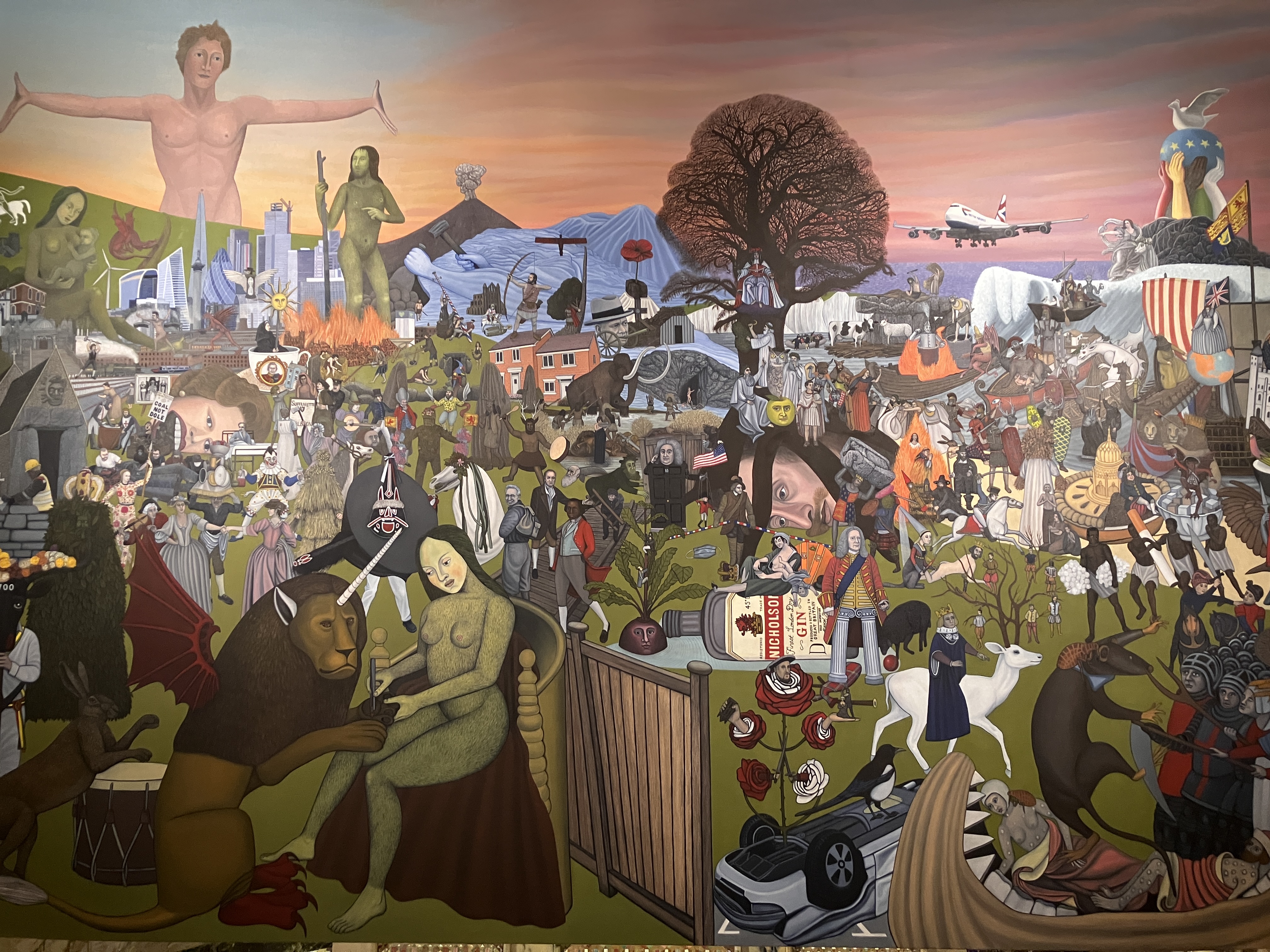
The centrepiece of the exhibition is the large painting Children of Albion, painted in 2025, which is positioned in the altar place of the chapel. This, in the grand tradition of history painting, offers us a history of Britain from ancient times to the present. It is a playful yet profound piece of artwork with sly comments, pointed art-historical references, contemporary jokes, and, above all, an aching love for these islands.
Edge’s style initially appears quite naive. It reminds me a little of Henri Rousseau, but upon closer inspection, I see the naivety is a deliberate choice to make the paintings feel friendly and inviting. Once you start examining them, you notice the relationships between the elements; you begin to see the uncanny and unsettling, and even recognise yourself within the paintings. Then there is everything else – the mythological, the downright spooky, the ghostly, the historical – everything that has ever existed and still exists, swirling around where the past becomes present and time no longer seems relevant. It’s epic.
I won’t say there aren’t criticisms of the artist’s work, though these don’t really come from me. But I have heard it said that Edge is just illustrating folk culture or folk magic, but I don’t really think that’s strictly true. I guess Edge quite rightly positions himself as the recorder, observer, and occasional participant, but he’s not claiming magical knowledge. He’s not claiming any role of shaman or expert. Instead, he is learning about it by painting it; he’s discovering Albion’s deep roots and the rituals and practices by visiting them and painting them. Here, painting is a way of Understanding, and I think this is translated to us as the viewers. I also believe that there’s something delightfully cinematic about Edge’s paintings they are in a sense rather literal at least on the surface and could be imagined as scenes from films. This is coming from me quite a compliment because I think that the cinematic in painting and the painterly in the cinema are about the highest level that either can achieve. Yes of course there is a residual flavour of THE WICKER MAN in these paintings but of course that film is as much part of our collective folk heritage as anything else.
There are issues in the contemporary art world with artists who have lately “discovered” esoterica, folklore, and magic and are incorporating them into their practice. Some of them are doing it only superficially. But this is not the case with Edge. He’s making a vital record. It’s not only about recording what people are doing; he’s inspiring all of us to look at the work we can participate in ourselves.
The Folk Renaissance is the name of Edge’s new film, a documentary of contemporary folk practices that he filmed across Britain, as we reclaim, reinvent, and re-create folk traditions from our experience of the land. It is a lovely film in which the artist allows people to express themselves genuinely and fully. I would love to see this film broadcast on television because it’s incredibly inspiring.
Of course I had to get a copy of Edge’s book FOLKLORE RISING an artist journey through the British ritual year, published by the wonderful Watkins books. It’s an absolutely lovely publication which I thoroughly recommend. If you’re too far away to come and see the exhibition (which in any case closes in a couple of days) you should absolutely have the book. Edge explains in the introduction how he got started with the project, what his influences were and why it’s important to him and then he goes through the wheel of the year with paintings commemorating all kinds of folk rituals up and down the country.
One of my particular favourites is the chapter on the Vale of the White Horse, which is an oil painting that also incorporates chalk from the Uffington White Horse, painted in 2022. The Uffington White Horse is an incredible sight, a white horse carved into the chalky earth of a large hill in Uffington, Oxfordshire. I visited it myself also in 2022; it is an incredibly beautiful place. In the book, Edge describes his visit to the Uffington White horse to witness the chalking (also known as Scouring) ceremony which he says has been taking place from as early as 1380 BCE which was when this mysterious stylised image of the horse was first carved into the hillside.
Edge writes, “When standing on top of White Horse Hill, one thing was clear to me: spiritually significant sites such as these choose themselves. The view was breathtaking. It felt like I was in a holy place, a skylark soared above me and next to my feet, a molehill revealed dug up pieces of the chalk hidden beneath the surface which had been sculpted by the melting ice caps during the ice age, creating a ripple pattern in the hillside that overlooks the six counties visible from the highest point of Oxfordshire”
I know exactly what he means because I had the same feeling when I stood on the top of White Horse Hill. I understood it was a sacred place, even though I hadn’t fully grasped what that really meant. As I stood on the ground and later sat and lay on it, I could feel the energy of the earth rising up through my shoes and into my body. I could sense something about how the rays of the Sun, the depths of the Earth, and the chalk all mingle together and flow through me, from top to bottom and bottom to top. It was uncanny and strange. I hadn’t quite experienced something like this before, if you want to call it sacred, so be it.
@ben_edge_art
 THE ART TRAVELLER
You must be logged in to post a comment.