Exploring “Patience in, Truth in Making” at Trinity Buoy Wharf
The John Ruskin Art Prize showcases outstanding multidisciplinary works that fuse technical mastery with deep ethical purpose. This year’s exhibition invites us to reflect on the profound relationship between artistic vision and skilled making.
From innovative sculpture to breathtaking drawing, the shortlisted pieces exemplify the enduring influence of Ruskin’s values in today’s art world.
The John Ruskin Art Prize is a UK multidisciplinary award inspired by the values of 19th-century author John Ruskin*. It supports artists, designers, and makers whose work crosses traditional boundaries, aiming to reflect Ruskin’s emphasis on art as a means to reveal universal truths. Founded in 2012 by the Guild of St George, the prize highlights the importance of integrity, skill, and ethical purpose in art. This year’s theme, “Patience in, Truth in Making,” explores how perception and creation interact, inviting artists to consider both their vision and how it may be interpreted. Ruskin viewed artistic creation as both a technical and spiritual pursuit, guiding artists to observe sincerely and craft with honesty.
The exhibition at Trinity Buoy Wharf in the Docklands presents an outstanding display of both art and craft, rooted in skilled technique and guided by artistic vision. This powerful combination is reflected in the shortlist featured in the exhibition. I visited the exhibition just before it closes this coming weekend along with some friends and we all enjoyed it. Here I will highlight my preferred pieces and as usual, provide my assessments of them. Please note that not every work could be included, and some excellent pieces may not align with my personal preferences and taste.
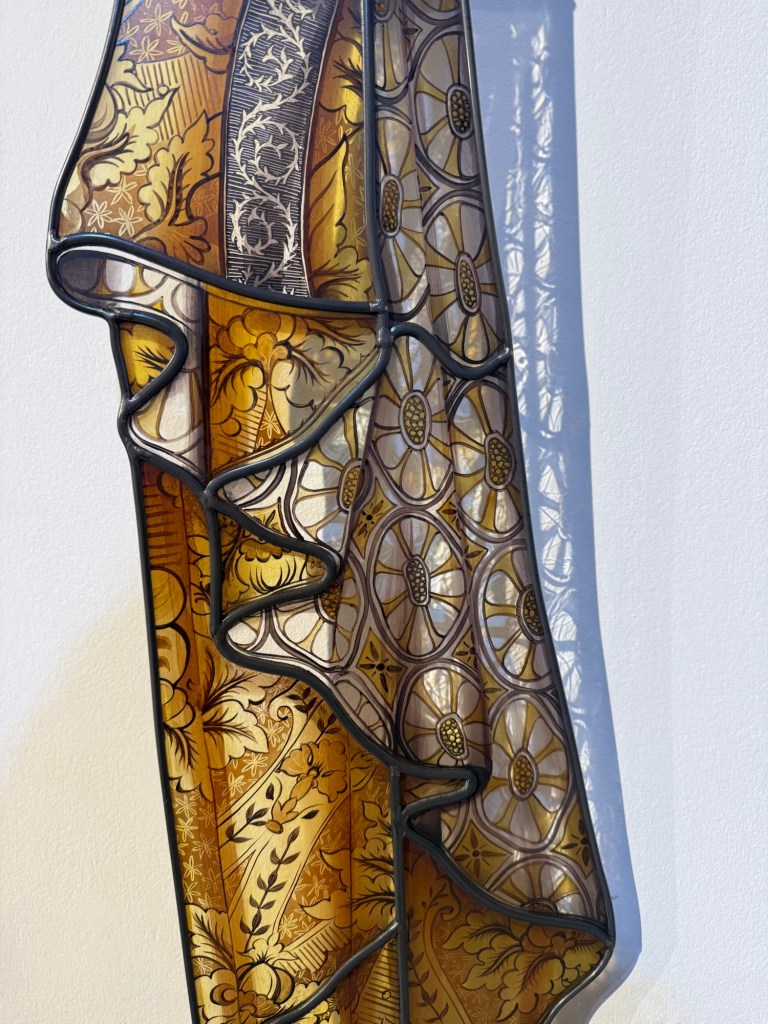
Ayson’s work was my favourite in the show and although I very often leave my favourites until last I just couldn’t resist starting with this exquisite work she presents two pieces of hand painted silver stained mouth bone glass suspended from rope and looking convincingly like draped transparent silk . A masterpiece of trompe l’oeile, Ayson’s silk flutters and shimmers and you can swear that it is fluttering in the breeze yet it clearly cannot – and there is no breeze. It’s so convincing and compelling is the work that although you know exactly that it’s glass you’re very tempted to believe that it is not. I love this idea of teasing the viewer but in such a sumptuous and generous way it makes the work not only exquisite but also fun and that’s always a good thing.
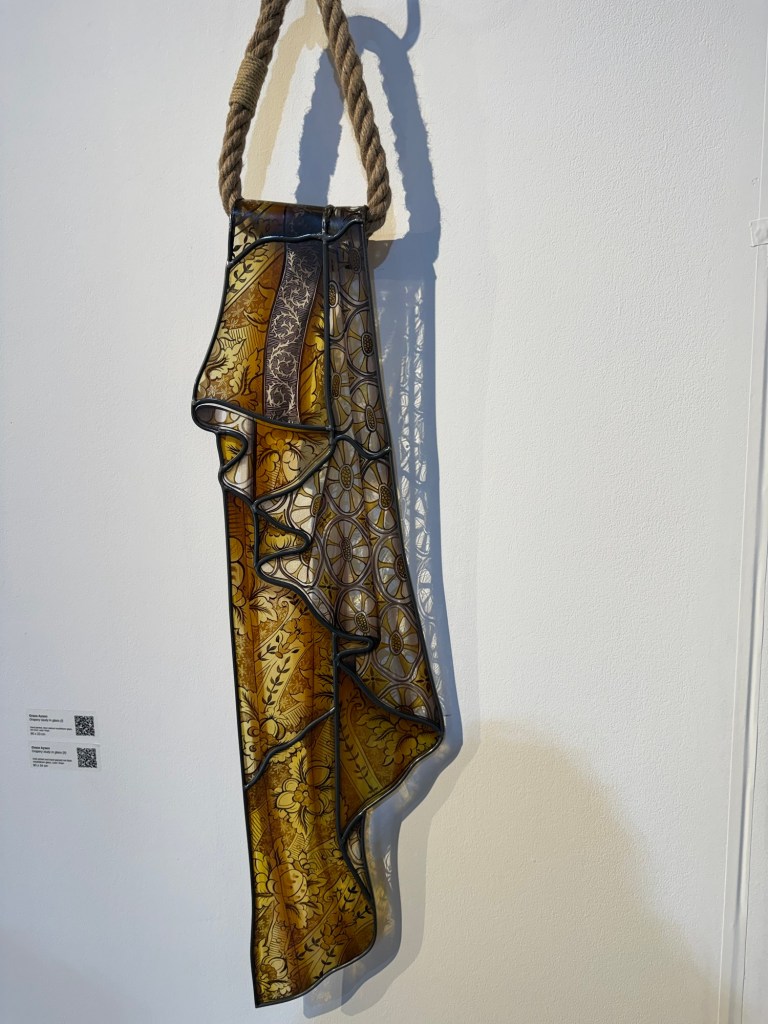
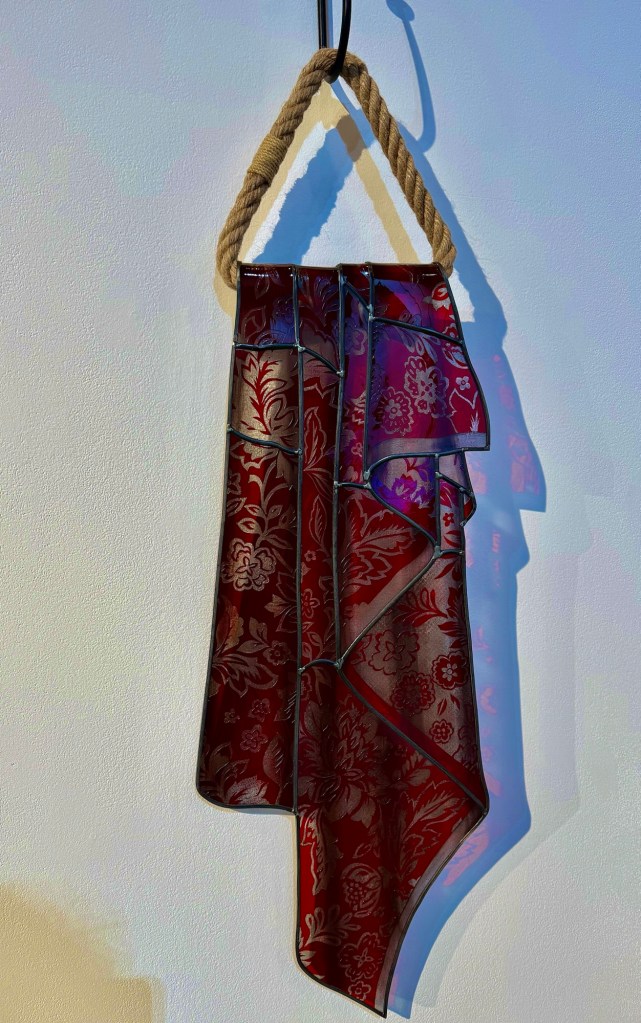
Drapery Studies is a series of works that observe and examine the fall, weight and subtleties of textile, and draws inspiration from the carved drapery of classical sculpture. It also echoes the stylised fabrics depicted in traditional stained glass windows and indeed in painting. I was strongly reminded of the drapery seen in paintings, especially portraits of the 16th 17th and 18th centuries. I’m reminded especially of the lavish and sumptuous folds of the dresses of Van Dyke’s and Gainsborough’s sitters. At the same time the presence of the coarse rope offers a jarring counterpoint to the delicate beauty of the glass. It suggests a cleaning cloth, a scarf or a handkerchief casually stowed, hanging in a convenient spot.. the juxtaposition is enticing and provocative.
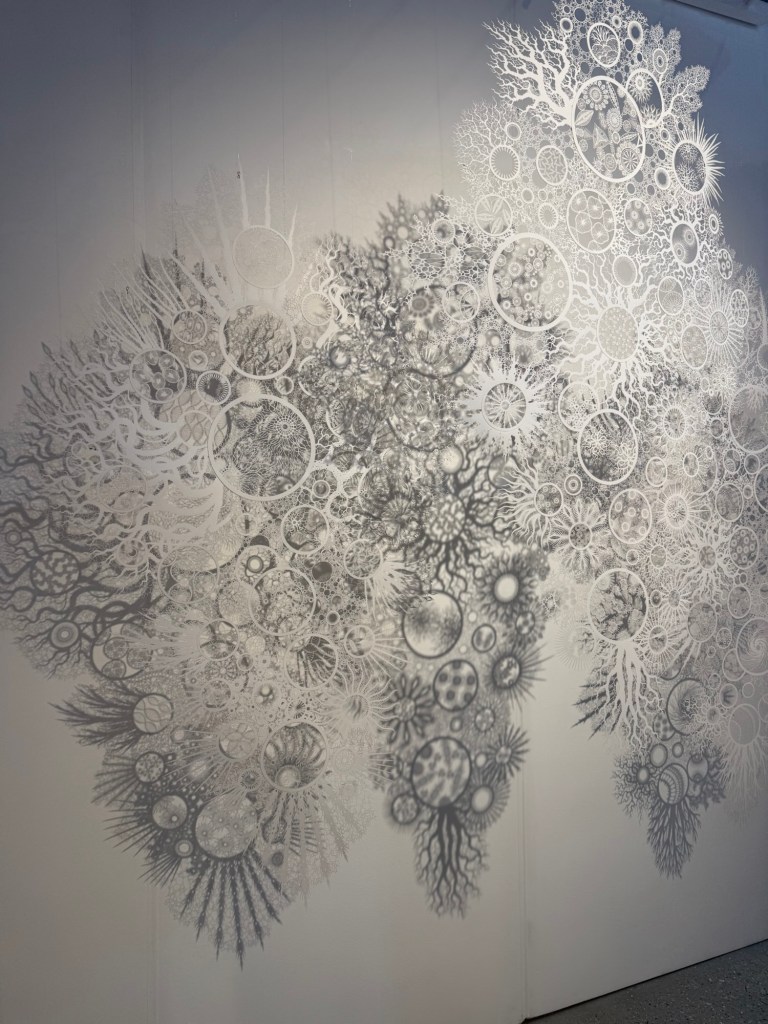
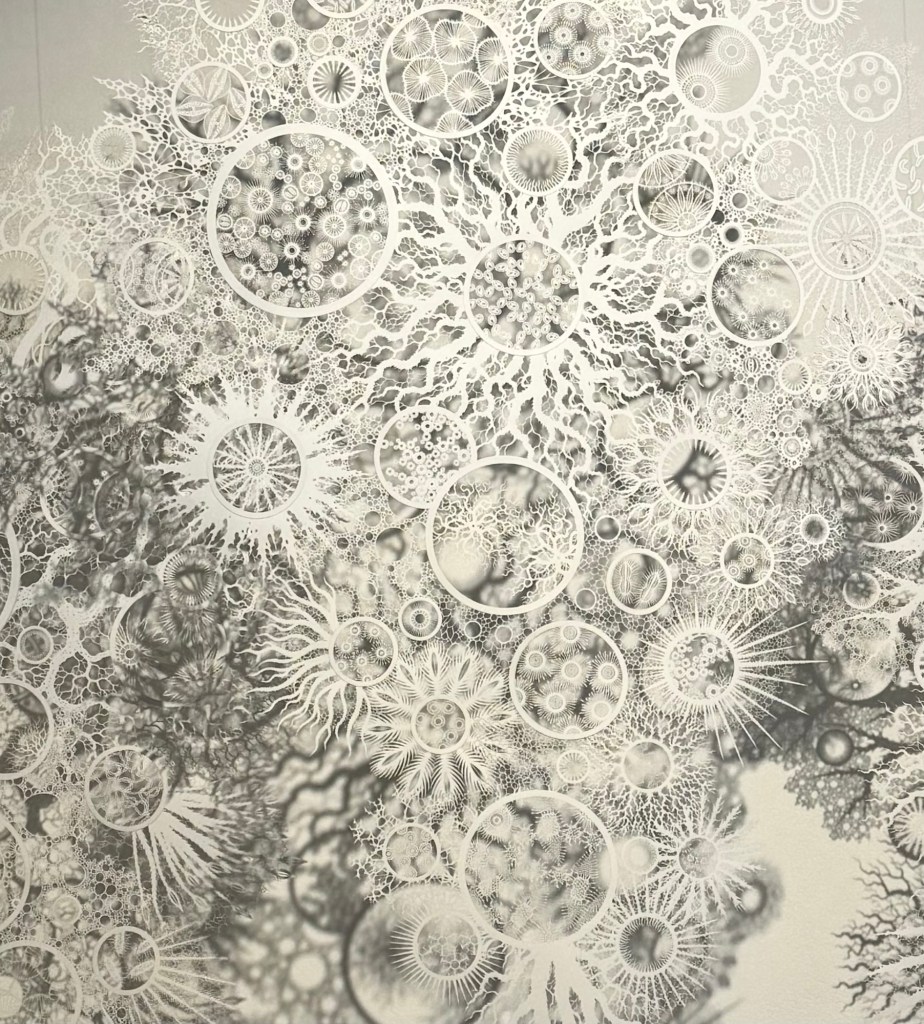
This large and incredibly detailed cut paper collage is especially striking as it is white on a white wall – and so you get not only the exquisiteness of the cut paper but also the shadow which has its own quality altogether. Brown’s observation of nature is aided by technology, particularly scientific imaging – microscope, satellites et cetera – offering the artist both microcosmic and macrocosmic imagery of the world and indeed the universe far beyond the limitations of the human eye
In this work the truth of sacred geometry is fully revealed as these natural forms, put together, cohere into something far greater than its parts, yet depends entirely on the tiny perfection of each part. According to the exhibition catalogue, each piece begins with observational drawing which is then made into a vector form, then transformed into laser cut paper and finally the hand collage sculpture. The ephemerality of paper has always been a challenge to artists and in this respect, as the catalogue entry points out, Cornucopia appropriately ‘evokes both the beauty and fragility of the ecosystems that we seek to understand and protect’.
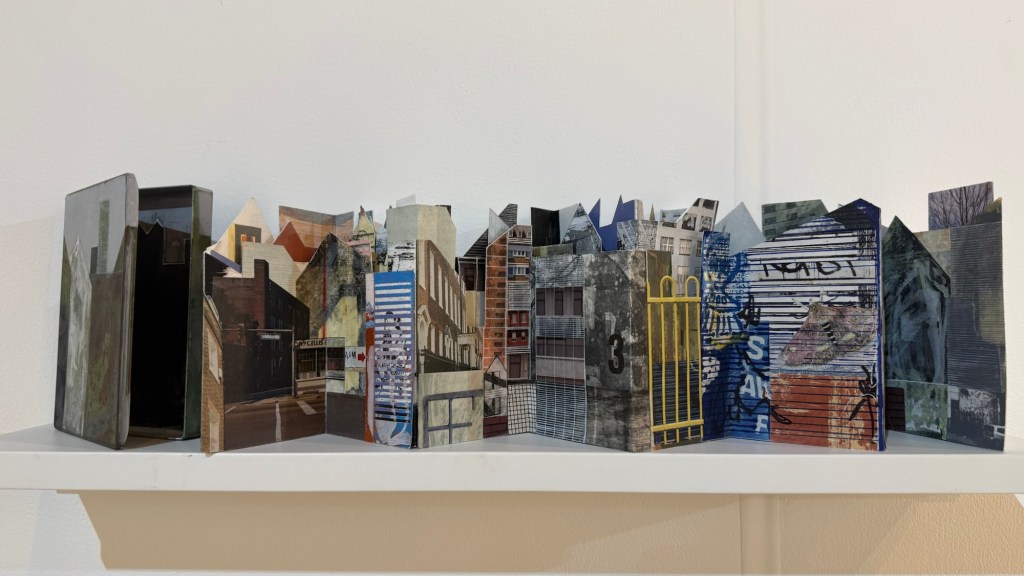
Hannah Frase mixed media artist book Forgotten Neighbourhoods is a small scale piece that could easily have been overlooked among the larger and more bombastic pieces in the show. I found it really profoundly moving and exquisite in its craftsmanship. It is a mixed media concertina book and I particularly like this form, which you don’t see as often as you should.
In order to re-create the ‘neighbourhood’- as the book forms an entire street- Frey starts with the observation of the urban environment and then uses a whole variety of different techniques: collaging together screen printing spray painting etching drawing and cyanotype. Again the microcosmic and the microcosmic are juxtaposed in this work as Fray reveals the biodiversity of urban environments, as nature reclaims abandoned spaces and animal and instinct life thrive in every nook and cranny. There’s something deeply familiar about Forgotten Neighbourhoods; we know these streets and these buildings and they make us sad and nostalgic . Meanwhile, its clever, playful construction allows an intimacy between the artwork and the viewer so it feels almost like a personal and private experience.
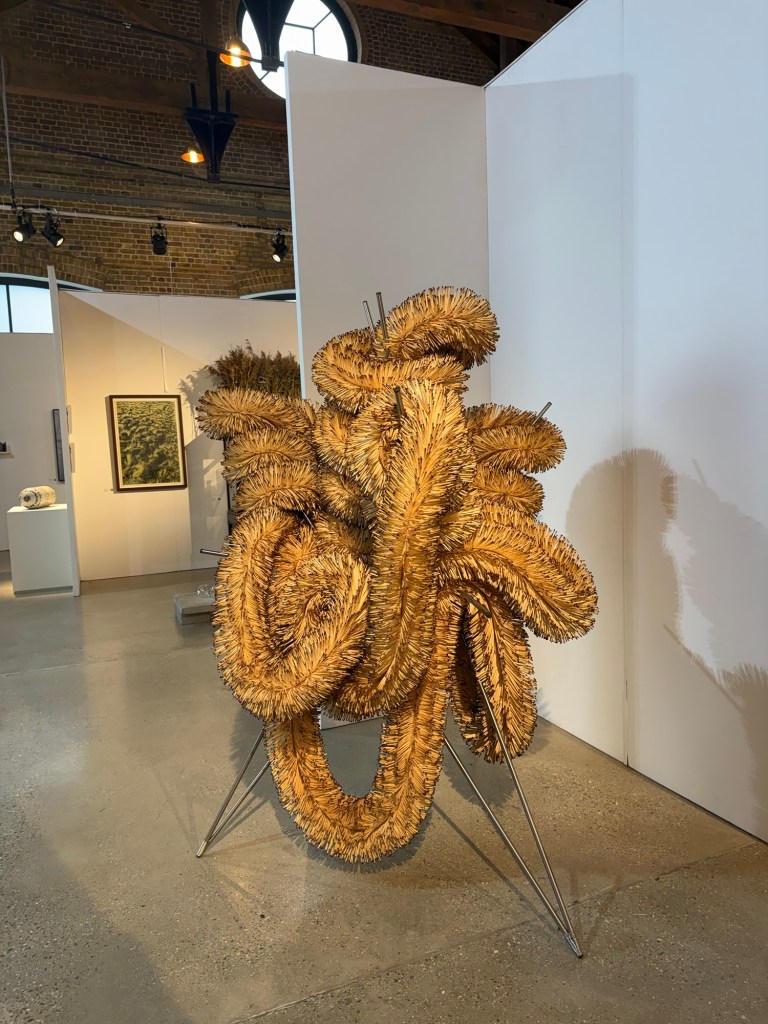
Calling this sculpture Relationship is certainly provocative—let’s just sit with that for a moment. To begin with, it’s an absolute tangle, almost like a knot of intestines that appears impossible to unravel without causing some sort of catastrophic damage. As a metaphor for a relationship, I’ll take it. But look a little closer, and you see it’s deeply, profoundly about connection. Thousands—and I do mean thousands—of spent matches are individually placed within a stainless steel mesh, yet there’s no adhesive holding them together.
Instead, it forms an interdependent structure, supported solely by friction and tension. What a metaphor that is! Each element shapes and supports itself and the others—together, they make up the whole. In short, it’s a model of the universe, an ecosystem, existence itself. It takes time to really look at it. At first, it’s quite bombastic: large, spiky, fascinating, and just a bit odd—in a good way. But the more you contemplate it, especially the process of its making, the more you’re drawn in. It reminds me a bit of that piece I saw by Claudia Martinez the other week, where the meticulous and painstaking assemblage of tiny parts results in something truly profound.
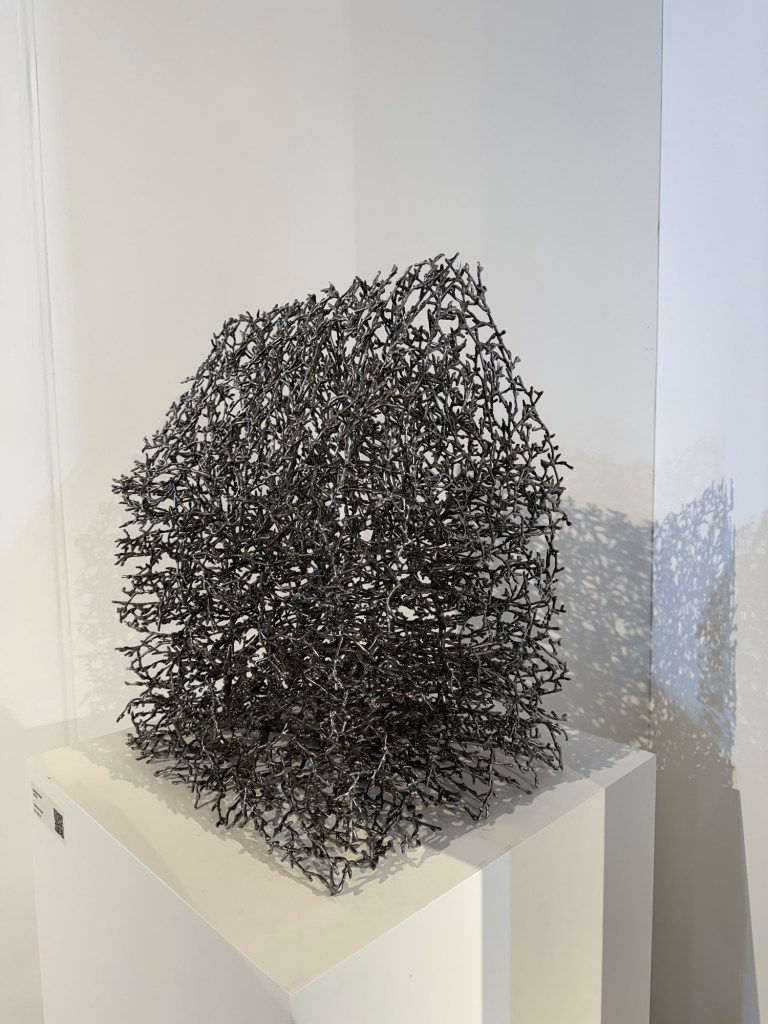
Calling this piece Airbnb is just so clever that I laughed out loud in the middle of the gallery. I mean, it’s a house that archetypal house shape that we learned to draw when we first given a pencil. And yet it is made of tiny pieces of stainless steel so it has a massive amount of airflow and it is in that case as in substantial to the idea of home as the Airbnb is wow. I love it when art really makes me think and recognise and then think again.
But the actual form is really interesting because it is organic and it comes out of organic. The artist studied how tumbleweeds twist catch and gather through movement and then translated these strange organic forms into hand welded shards of steel. A tumbleweed,if you’ve never seen one is a weird plant. It is a diaspore that, once mature and dry, detaches from its root or stem and roll due to the force of the wind. It survives by moving and keeping a circular form through friction as it tumbles and spreads it seeds; it can’t stand one place.
Even more interesting when you think about the metaphor is when you reflect on the fact that the tumbleweed is both a symbol of the American West and is considered a noxious weed throughout North America. Like Airbnb maybe?
There are a range of other works in the show which I really enjoyed but which did not photograph well in situ. This in particular this applies to the drawings and paintings such as Kim Anderson‘s wonderful peace all the beauty and the terror gorgeous drawing of the suns rays piercing through the trees on a winter morning – achieved through ink, graphite charcoal and cold wax on paper. Camilla Brueton’s series Tax Office Series Selection I, drawn in pencils and chalk upon used envelopes documents the demolition of 18 story Tower block in Cardiff, that had originally been taxed office .
As she was observing the demolition of the enormous block the artist sketched in the street, and encountered many people who are willing to talk to her about their feelings about the building and even their experiences in working there. I particularly like the idea of ‘drawing on the back of an envelope’ which is how architectural ideas are often described the idea that an architect gets inspiration and reaches for the first piece of paper they can find the idea of the back of an envelope being taken literally in this case draws attention not only to the saying, but also to the fact that the back of an envelope can be an extremely interesting surface.
I was sorry that my photograph of Beverly Duckworth’s piece Anthesis III didn’t turn out well enough for me to post here because this piece is truly fantastic. It is a living drawing created by sewing seeds onto cloth in an intricate and ornamental pattern that references the botanical aesthetics of William Morris. As the seeds germinate and grow the artistic design is gradually revealed and then obscured through nature writing its own form, overtaking the human made as is always the case. It is a piece that comes into being through a process of slow transformation and in this exhibition we are able to catch it at only one stage of its existence. I’m very curious to what happens to it after this show. Certainly it’s a very beautiful aesthetic piece, but it’s also complex and like many of the other pieces in this exhibition quite provocative.
I found myself genuinely captivated by Rose Jones’s large drawing, River Severn Trees. The piece, rendered in photorealistic coloured pencil, beautifully captures a riverside thicket. What struck me most was the artist’s ability to translate the subtle variations of green found in nature into art, despite the limitations of available pigments. As I studied the drawing, I appreciated the meticulous layering and blending required to evoke the depth, texture, and richness of the scene. It reminded me how challenging—and rewarding—it can be to convey the complexity of what we see in the natural world through artistic skill and patience.
Those are my highlights from the John Ruskin Prize 2026, and I’m genuinely glad I stopped by. I visited the exhibition twice—first on my own, then returned with friends—and we all generally agreed on the pieces we liked. In fact, there wasn’t anything we didn’t enjoy, but these were our standout favourites. The glass installation, in particular, made it well worth venturing all the way to the Docklands. This prize is truly worthwhile and the exhibition itself is genuinely impressive; it’s a real asset to London. I only wish it had been better publicised, as many people I spoke to afterwards hadn’t even heard about it, which is a shame.
 THE ART TRAVELLER
You must be logged in to post a comment.