ISTANBUL MODERN

Ömer Uluç’s (1931–2010) retrospective, “Beyond the Horizon,” showcases the evolution of his art over time, featuring over 300 works from the 1960s to 2010 that demonstrate the artist’s means of expression as he explored various themes. The exhibition features examples from various fields, including paintings and drawings, collage, and sculpture, in materials including rubber, felt, aluminium, acrylic, PVC, and all kinds of found objects. Uluç examines the complex interaction between humans and the universe, primarily expressed through the motif of the spiral or gyre.

The spiral is a symbol with origins in prehistory, its form appearing across nature and art. It represents the cycle of life, from birth and growth to death and reincarnation. Its shape is found in seashells, pinecones, and the helix of DNA, evoking the idea of evolution and expansion from a central point. The motif also signifies nature’s patterns, such as the seasons and the orbits of celestial bodies. In matters of spirit, the spiral suggests a journey from the world of the ego to the inner soul, representing a path to enlightenment and a connection to a source of creation. The spiral held significance for many civilisations throughout history. To the Greeks, the shape signified vitality. For the Celtic peoples, the triskelion—three conjoined spirals—stood for the unity of past, present, and future. The spiral is also recorded among the Sumerians and the Egyptians and is a foundational and widespread motif in Islamic art.

It is often a core component of the biomorphic patterns known as arabesque or Islimi. The spiral serves as the fundamental structure from which other elements, such as leaves and floral motifs, sprout and grow. Inspired by the movement in nature, this form symbolically represents the progression of creation from a single source, moving outward toward infinity, and embodies the underlying order and unity of the natural world. The spiral’s significance in Islamic art extends beyond mere decoration to hold sacred and spiritual meaning. The rotational quality of the arabesque can be seen as a visual parallel to the whirling dances of Sufis, which in turn symbolise the motion of all particles and celestial bodies around a divine centre, expressing unity with God. Uluç, heir to many traditions, ancient and modern, was also a world traveler who absorbed the traditions of the many places he alighted: Mexico, the US, Paris, and Nigeria. Therefore, his conception of time and place is different, more fluid, and mutable compared to that of a person who remains in one location or holds a fixed set of ideas.
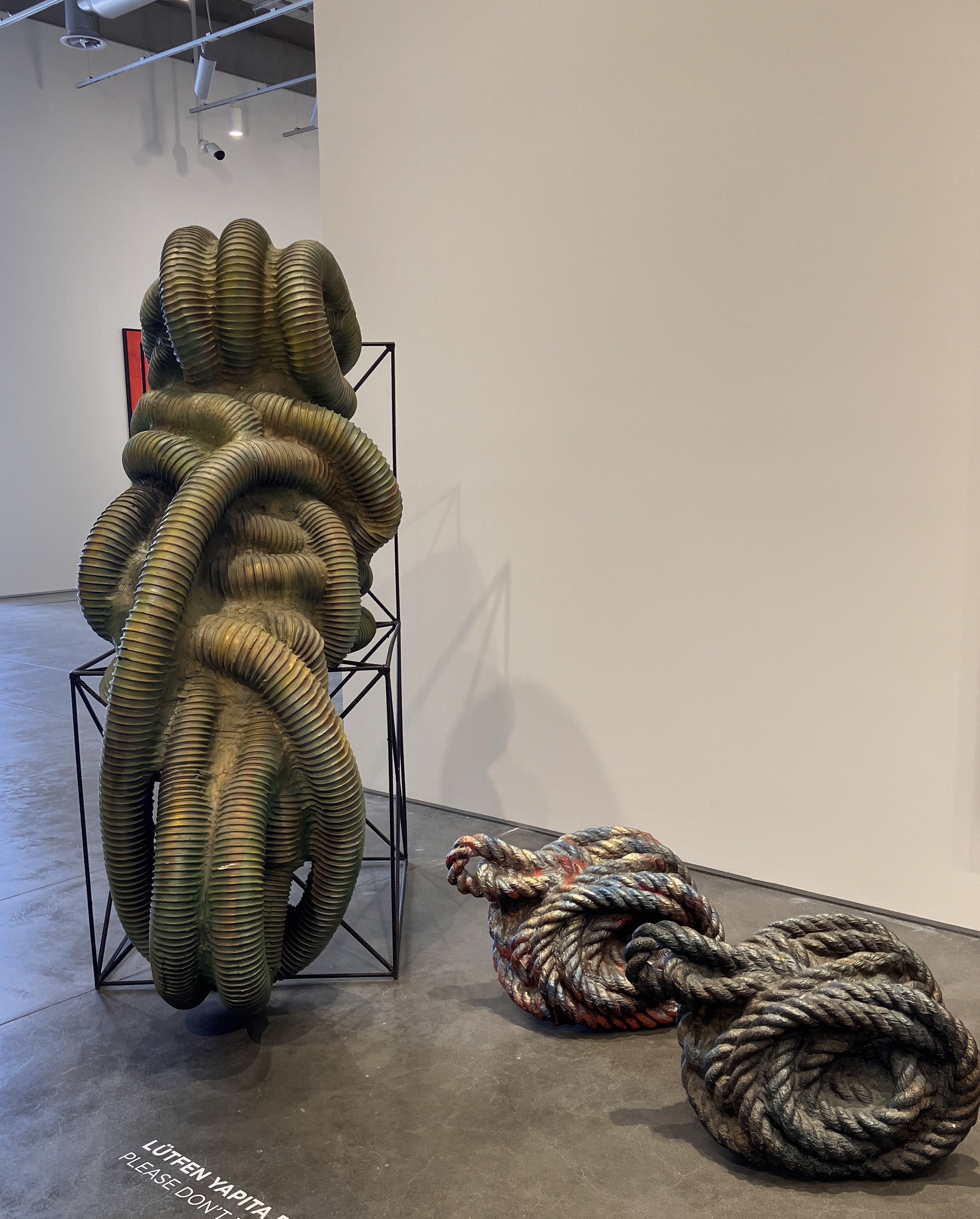

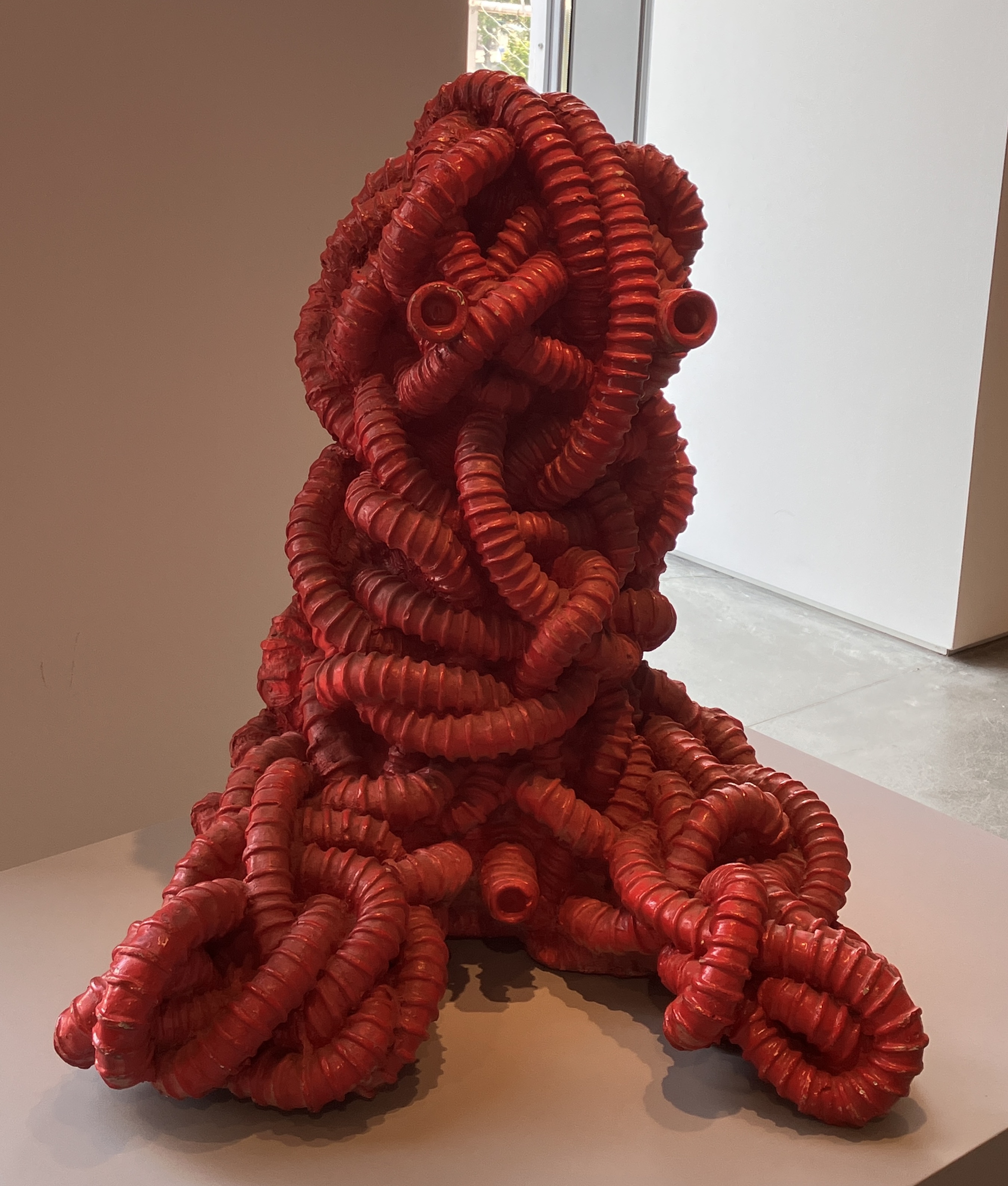

Uluç’s world, as expressed in his works, is one made up of spirals. A gyre, or vortex, is a kind of spiral, whirling in circles like an ocean current or a spinning body or particle. The poet Yeats conceived of history as moving in interlocking gyres, each one representing an epoch. For Yeats, history alternates between ages of order and ages of chaos. The collapse of one gyre signals the dawn of its opposite, heralding a new and turbulent age. An echo of Yeats’ notion of spiral time is suggested by the artist himself in the film interviews, which I found fascinating (I watched them all, which I almost never do.)

Uluç’s artwork utilises the spiral as a centring motif, effectively communicating a spectrum of concepts from cosmic order to psychological states. As Van Gogh employed swirling, energetic spirals to animate the sky in The Starry Night, and Kandinsky saw the form as an expression of spiritual energy, Uluç’s spiralling shapes create all the forms that make up the universe. Uluç’s artistic journey, marked by the recurring motif of the spiral, offers a profound exploration of both cosmic order and the intricacies of psychological states. Through his work, he weaves together a tapestry that resonates with the emotional depth found in van Gogh’s “The Starry Night” and the dynamic energy of Kandinsky’s “Spiral of Energy.” This connection not only highlights Uluç’s innovative approach but also underscores his ability to encapsulate all forms of the universe within his art. By synthesising these elements, Uluç invites viewers to engage in a dialogue about the interconnectedness of existence, urging us to reflect on our place within this vast cosmic narrative.

https://www.istanbulmodern.org/en/exhibitions/omer-uluc-beyond-the-horizon
ISTANBUL MODERN is located at Galata Port and is easily accessible from Galata and Karaköy Ferry Port. It has a great cafe and terrace, lovely gardens and is well worth a visit. Admission 750TL. Closed Mondays.
 THE ART TRAVELLER
You must be logged in to post a comment.