West Coast Art Travels
August at the Vancouver Art Gallery was unforgettable! This month, I explored three incredible exhibitions it would’ve been a pity to miss. The highlight for me was Jean Paul Riopelle, the legendary French-Canadian abstract artist whose career in Europe and return to Canada are beautifully celebrated through paintings, prints, sculptures, and works by his contemporaries.
I also stepped into the magical world of Otani Workshop from Japan, where strange yet charming characters—full of folk culture, myth, and a cheeky sense of humor—brought out the inner child in me.
Finally, I experienced a powerful artistic dialogue between painter Lawrence Paul and video artist Paul Wong – part of the VAG’s inspiring “Art Conversations” initiative. Their works tackle themes of landscape and catastrophe in profoundly different, thought-provoking ways.
Riopelle
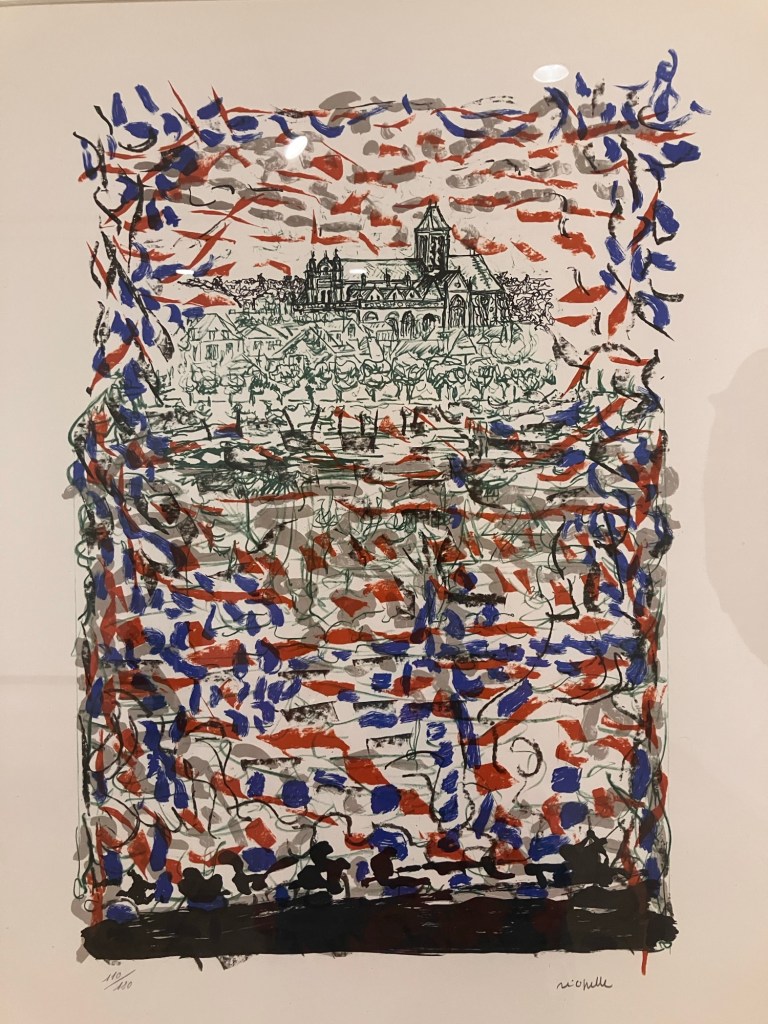
Jean Paul Riopelle (1923–2002) was a trailblazer in Canadian art, known for his stunning abstract paintings and boundless creativity. Born in Montreal, he was part of the revolutionary artist group Les Automatistes. Influenced by Surrealism and other esoteric tendencies in modernism, he learned to embrace spontaneity, letting intuition guide his work—a philosophy that shaped his entire artistic journey.
In the late 1940s, hungry for inspiration, Riopelle moved to Paris and into the city’s buzzing postwar Surrealist scene. Here he picked up influences that pushed his art in exciting new directions. Riopelle became famous for discarding the paintbrush in favor of a palette knife, slathering on thick swaths of paint. The result? Bursting, colorful “mosaics” – that feel alive with energy—like visual jazz. His best-known works from the 1950s are wild, textured, and completely unique, bridging the world of French Lyrical Abstraction and action painting.
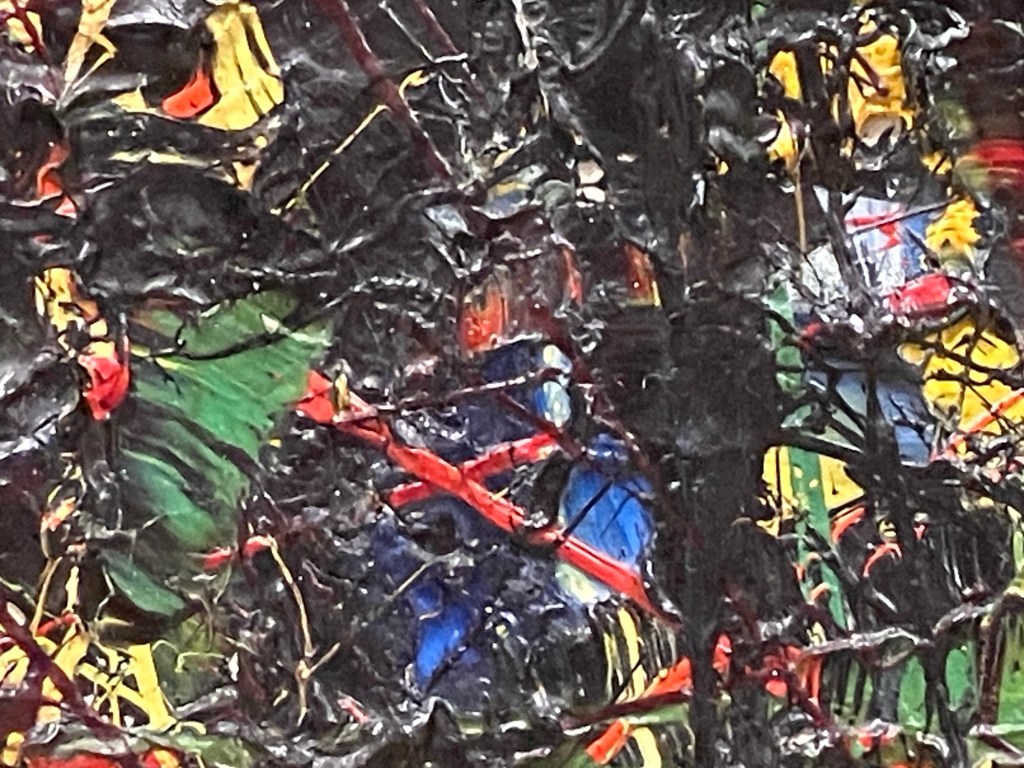
Riopelle is has sometimes compared to Jackson Pollock and this was a charge that he was annoyed by in the early 1950s. He and Pollock had methods. Although chance and the possibilities of the texture of paint were concerns of both artists their methodology was completely different: Pollock famously dripped the paint onto a floor based canvas using a variety of sticks. Where is Riopelle put his canvas on an easel and applied paint directly with pallette knives. The result is very different even if some of the motivation may be similar; and when you look at them live they are extremely different. This is one of the problems with photographing art. It’s flattened out and you don’t really get to see exactly what’s going on. I love both Pollock and Riopelle but they are really different. if someone was to actually put them side-by-side in the gallery you’d really see it.
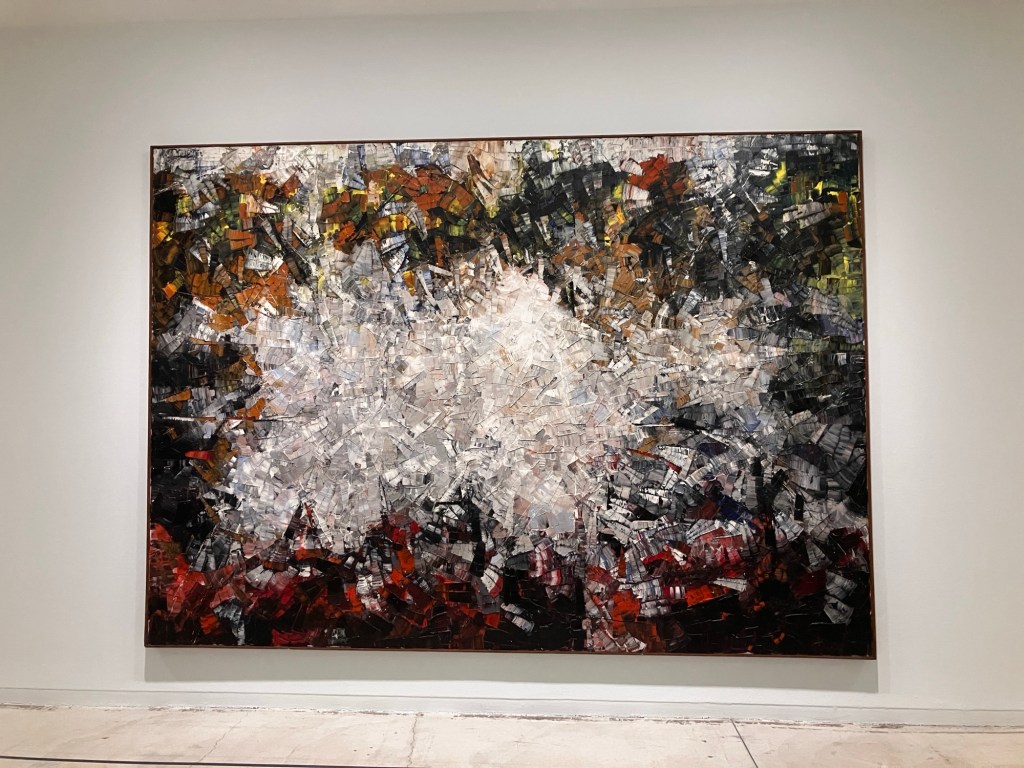
Over his career, Riopelle produced a staggering range of work—from lush, impasto-filled canvases to massive sculptures, prints and intricate collages. His art is all about movement and freedom, rejecting strict forms for raw emotion and instinct. Riopelle’s work is a testament to his adventurous spirit, earning him international admiration and making his creations staples in museums across the globe. In this comprehensive exhibition, you can feel the passion and innovation that define Riopelle’s legacy.
Otani Workshop: Monsters in My Head
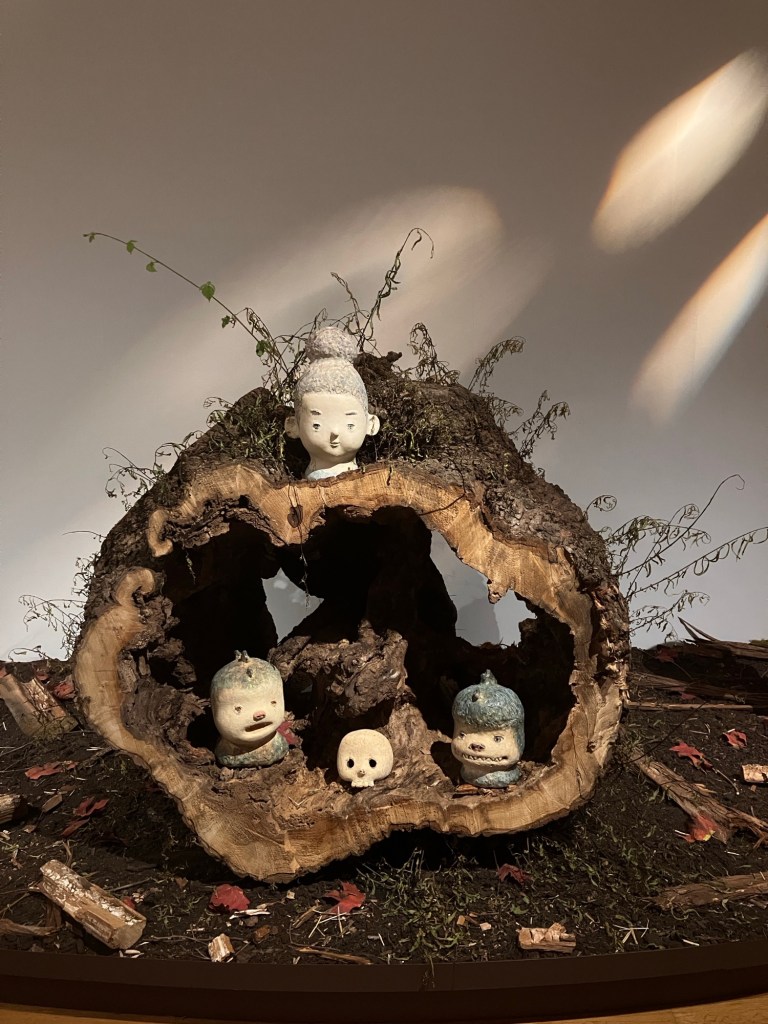
Otani Workshop is the name used by Shigeru Otani, a Japanese artist who works primarily solo in a former tile factory on Awaji Island, Japan. His studio features a large restored kiln and is situated near the sea, allowing him to incorporate materials like wood and iron found on the island into his ceramic sculptures. Otani began by studying ceramics at Okinawa Prefectural University of Arts and spent nearly a decade refining traditional clay techniques in Shigaraki, a region renowned for pottery.
Otani’s move to Awaji in 2017 allowed him to create larger works and experiment with new forms and materials, continuing the legacy of Japanese ceramics while developing a contemporary, personal style. He works long hours, often monitoring the kiln throughout the night, combining time-honored methods with intuitive, experimental approaches. His art blends traditional raw clay textures and imperfect forms with expressive features and a playful sensibility. The studio, filled with both utilitarian vessels and figurative sculptures, serves as a laboratory for his ongoing exploration of scale, materiality, and presence.
Although the name “Otani Workshop” suggests a collective, Otani works independently, drawing inspiration from both folk tradition and the natural landscape of Awaji Island. His works often evoke the idea of yorishiro—objects which serve as vessels for spiritual presences in Japanese folklore.
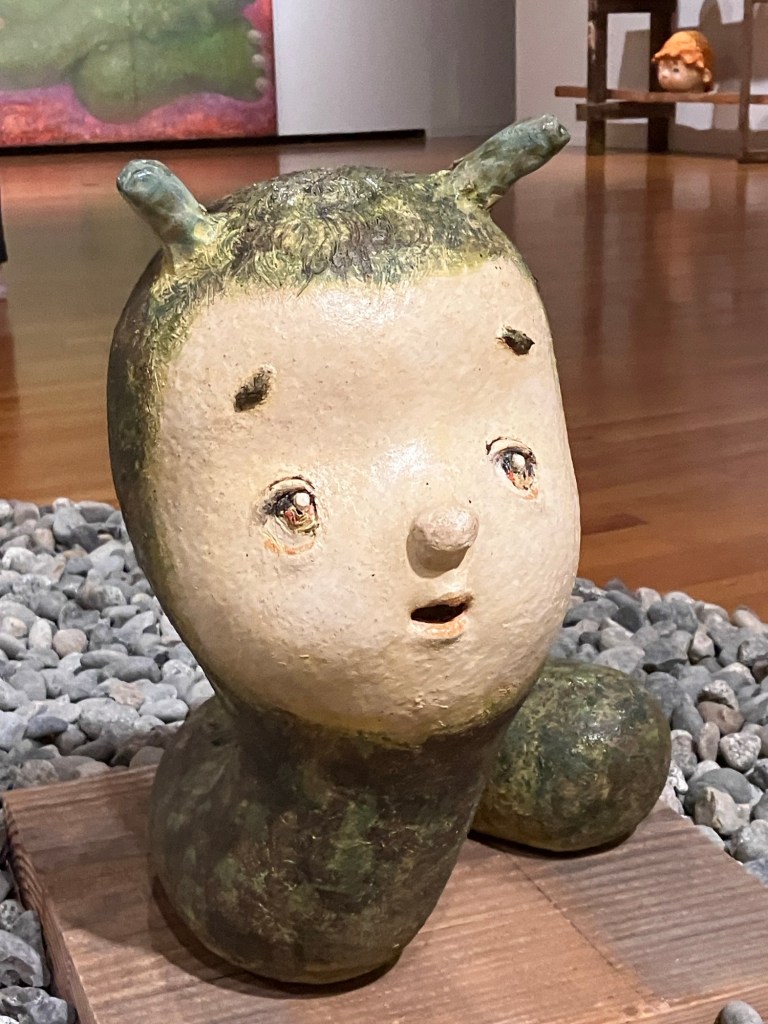
This show, Monsters in my Head (great title) is really an enchanted dreamworld—a disquieting landscape where myth and memory flow together, animated by the artist’s superb command of clay. Here, familiar forms twist into strangeness: creatures of ambiguous scale and aspect emerge from earthen mounds and fractured trunks, their glimmering eyes and textured skins evoking spirits both ancient and immediate.
Size becomes a spell. Some figures loom with an unexpected monumentality, their presence crowding the edge of comfort; others crouch or huddle, scaled down yet charged with an eerie intimacy. This manipulation of dimension disorients—pulling visitors into a terrain both immersive and destabilizing, where the boundaries between childhood reverie and primordial myth blur.
Paul Wong and Lawrence Paul: Artists 1:1
“The impulse to make connections between objects is a nearly universal experience. Artists are always in dialogue with their predecessors and peers, and they often make astute curators. 1:1 Artists Select is a new initiative that invites artists to select a work from the Vancouver Art Gallery’s extensive collection to be displayed in dialogue with their own work in the Forecourt.
The seventh and final artist to participate is Vancouver–based Paul Wong. He has selected a work from the collection by Lawrence Paul Yuxweluptun Lets’lo:tseltun.”
Pairing paint and video can sometimes go wrong but it works beautifully here. I availed myself of a small stool and watched first Wong’s intro, which you can watch above. Then I moved the stool and watched Lawrence Paul’s large striking canvas. After a while spent observing it, I stood and moved closer, immersing myself in the fiery landscape. This is a painting that expresses so much: anger, melancholy, endurance and faith in spirit. Th-e complex motif of fire: the destroyer that also clears the way for rebirth, is powerfully presented here.
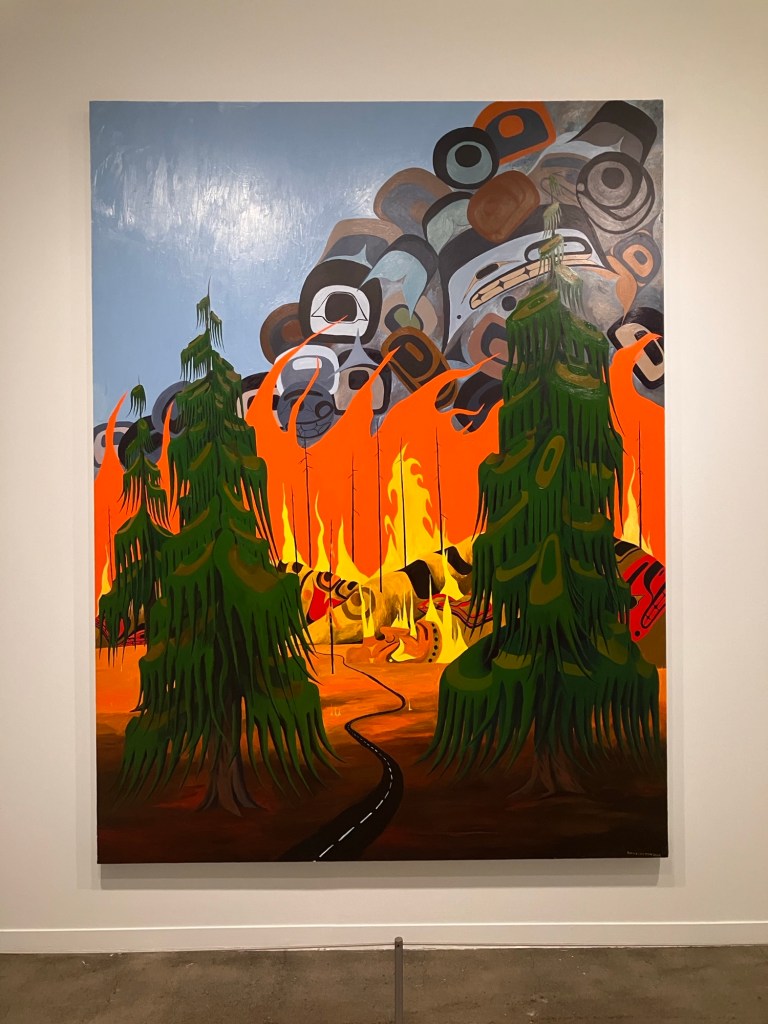
In his work Havana Riviera, Wong turns to another element: water. Here the city of Havana is obscured in a torrential rainstorm, Like Lawrence Paul’s fire, it is terrifying and all consuming but it also has the power to cleanse. Cleanse what? Ideas, prejudices, assumptions?
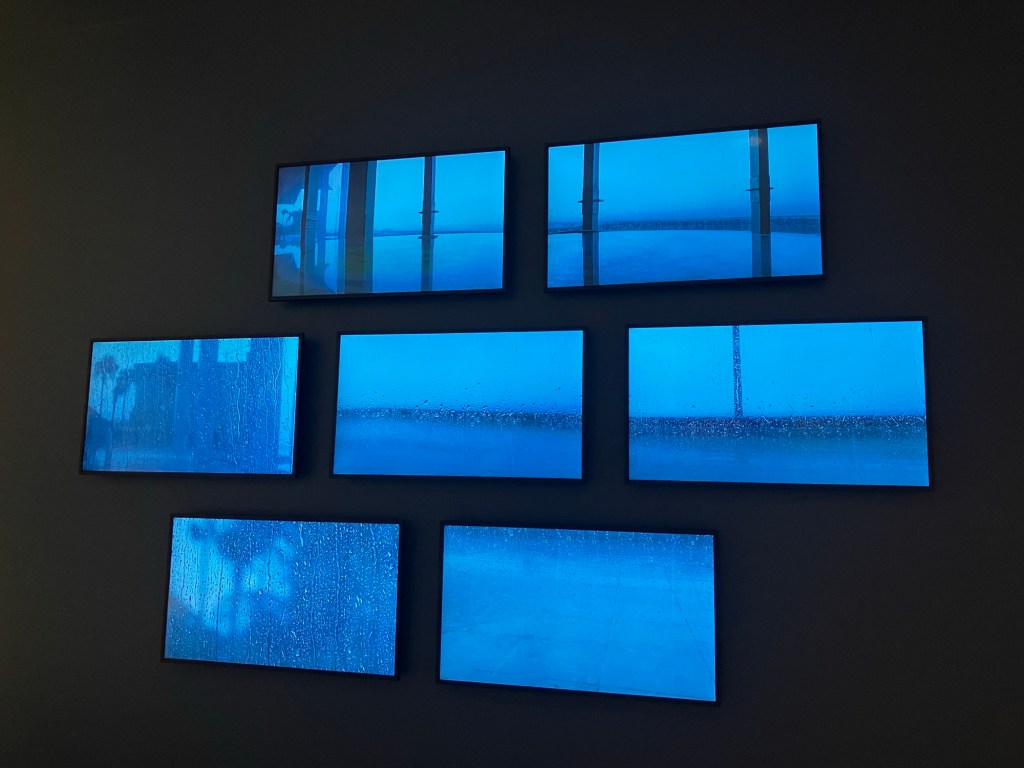
Both artists use apocalyptic motifs of fire and flood to invite the viewer to feel – then think- in new ways. In the art historical tradition of “disaster painting”(think about John Martin or late Turner, or Francis Danny’s The Deluge) Paul and Wong invoke the mythic concept of a world reclaimed by nature, forcing us remember how fragile it all is.
https://www.vanartgallery.bc.ca/
The Riopelle show closes Sept 1. Art travel tips for Vancouver: the VAG is big so allot a proper half day. Lots of eateries nearby and the gallery has a cafe. If you have only limited time in Vancouver, make you visit VAG and the Museum of Anthropology and check out the murals on Main St.


You must be logged in to post a comment.