From Stephen Lawrence to Grenfell: How Chris Ofili Paints Public Grief and Resilience
Separated by twenty-five years, Chris Ofili’s Turner Prize-winning painting No Woman, No Cry and his monumental Grenfell Tower mural Requiem at Tate Britain transform collective grief and British injustice into enduring sacred art.
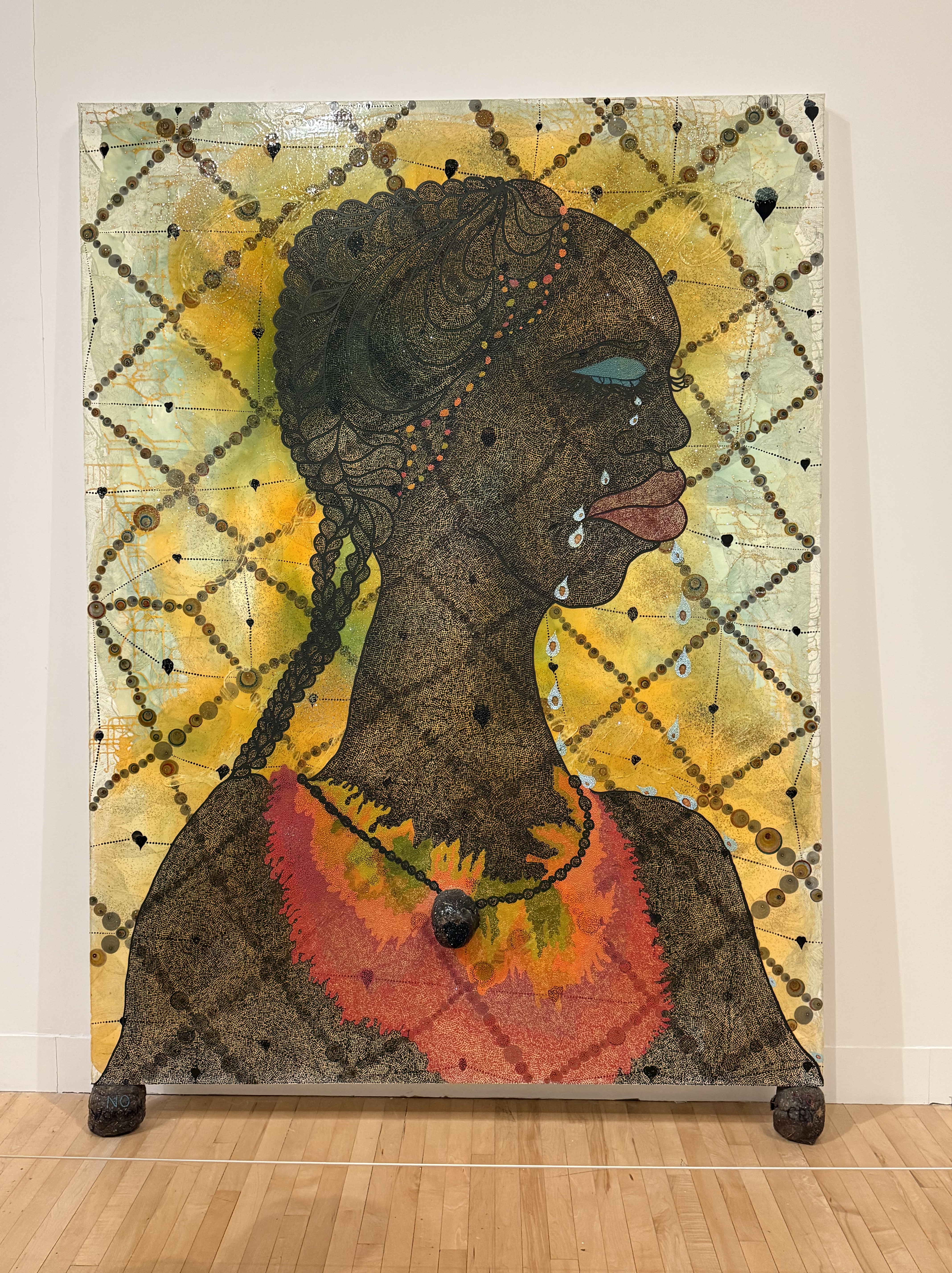
I first saw No Woman, No Cry (1998) by British artist Chris Ofili when he ‘exploded’ as part of the YBA Generation of artists. The 1997 show Sensation! at the Royal Academy marked the 42 participating artists as indelibly as a tattoo. All the press around that group of artists was for years about sensationalism, and Ofili’s work was not immune to that.
Ofili did play along. He didn’t present this piece, but instead exhibited The Holy Virgin Mary (1996) — which later became the flashpoint of a major First Amendment battle with Mayor Rudy Giuliani when the show toured to the Brooklyn Museum in 1999. Giuliani lost his case, and everyone in London pitied the New Yorkers because when the painting was shown here, everybody liked it or at least didn’t try to ban it.
However, the focus on sensationalism and YBA meant that people often did not benefit from discussing the artists’ work beyond those categories, which was a major disservice to the artist. Fortunately, between 1998 and 2015, critical writing on Chris Ofili underwent a dramatic transformation—moving from tabloid sensationalism and debates over race and irony to formalist celebration of him as a modern colourist and master painter. Still, while that is great, his importance as a Black British artist with significant things ot say about race must not be overlooked. But Ofili demanded – rightly – to be taken on his own merit and resisted the expectation that Black British artists act as earnest spokespeople for a single political message, instead using Blaxploitation tropes, hip-hop references, and “Captain Shit” to satirise both racial stereotypes and white liberal expectations.
Ditching the YBA label
When Ofili became the first Black artist to win the Turner Prize in 1998, British tabloids still routinely dismissed him as the “elephant dung painter”. The Tate website explains No Woman, No Cry as being made of ‘Oil paint, acrylic paint, graphite, polyester resin, printed paper, glitter, map pins and’ – er – ‘elephant dung on canvas’. During the heyday of sensation and its aftermath, all the focus was on the elephant dung. Serious art critics, however, pointed out that this picture— a luminous tribute to Doreen Lawrence, mother of murdered teenager Stephen Lawrence—was proof that his ornamental, glitter-and-resin surfaces could carry profound grief and moral weight rather than mere YBA shock value.
While much 1990s YBA work leaned on cool detachment or shock value, Ofili’s use of the visual language of religious icons and ornate decoration to convey genuine moral seriousness, subverted YBA tropes without slipping into didactic propaganda.
Ofili moved to Trinidad in 2005, and his work changed significantly. He abandoned elephant dung, glitter, and map pins in favour of fluid oil washes, nocturnal indigo canvases, and mythological figuration—prompting a major critical reassessment during his magnificent 2010 retrospective at Tate Britain. By that time, the notion of him being a YBA artist had, fortunately, already faded. The label had served many artists well, in that it got them pinned on the British and International art map, but for some, it was a millstone.
The Grenfell Mural
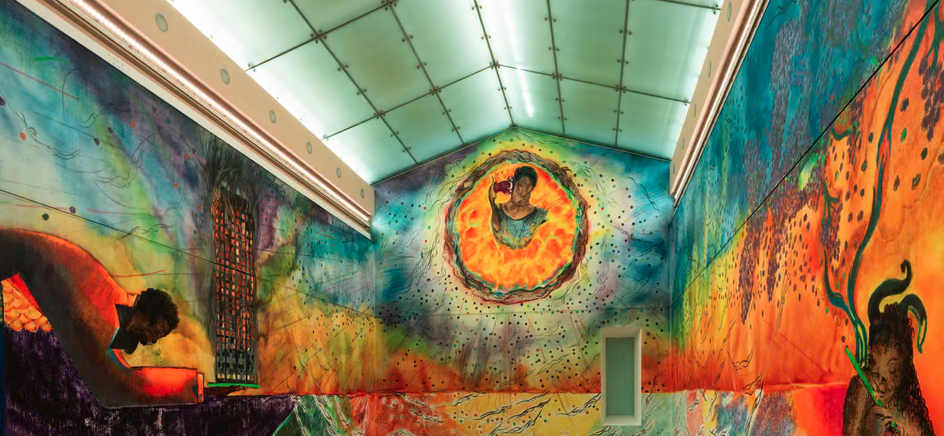
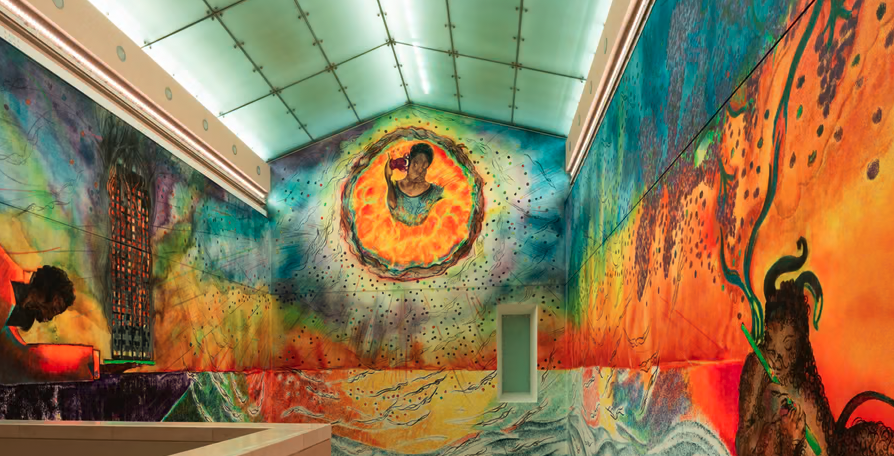
Unveiled in September 2023 on the north staircase of Tate Britain, Chris Ofili’s monumental, three-wall mural Requiem commemorates the 72 victims of the June 2017 Grenfell Tower fire and pays direct tribute to fellow artist Khadija Saye, who perished in the blaze alongside her mother, Mary Mendy.
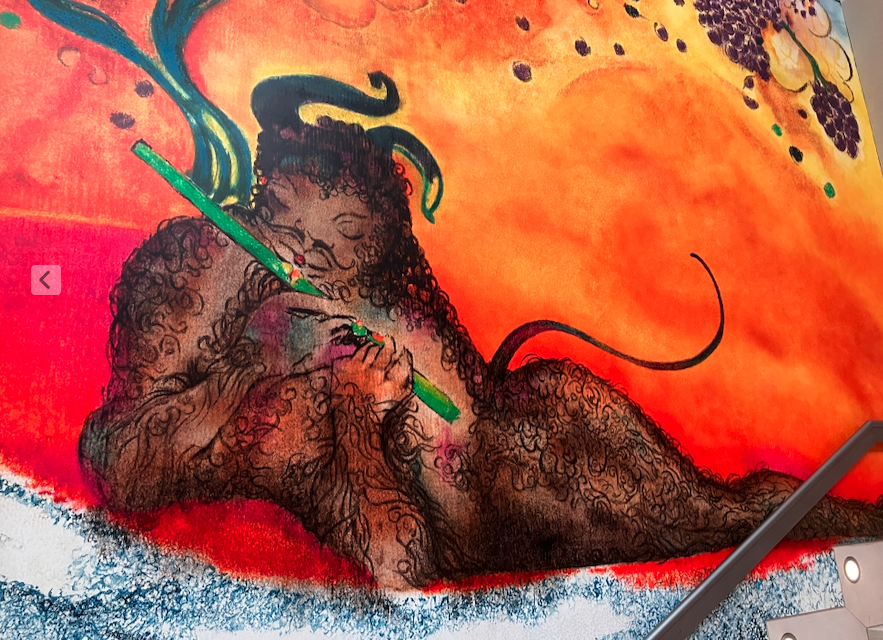
Requiem is stunning, immersive, beautiful and as deeply spiritual as a classic stained glass window in a baroque church. In fact, it has more in common, aesthetically, with stained glass than it does ot the mural as an art form. Ofili allows the painterliness to kind of dissolve and shimmer, so its materiality is almost lost. We are looking at pure colour as emotion. I defy anyone to look at this mural, to stand inside it and not feel a tear. You have to stand inside it because it takes up a whole staircase at Tate Britain, so you can experience it immersively, like you can in a church. It is remarkable. There is something generous and sacred about Ofili’s painting here.
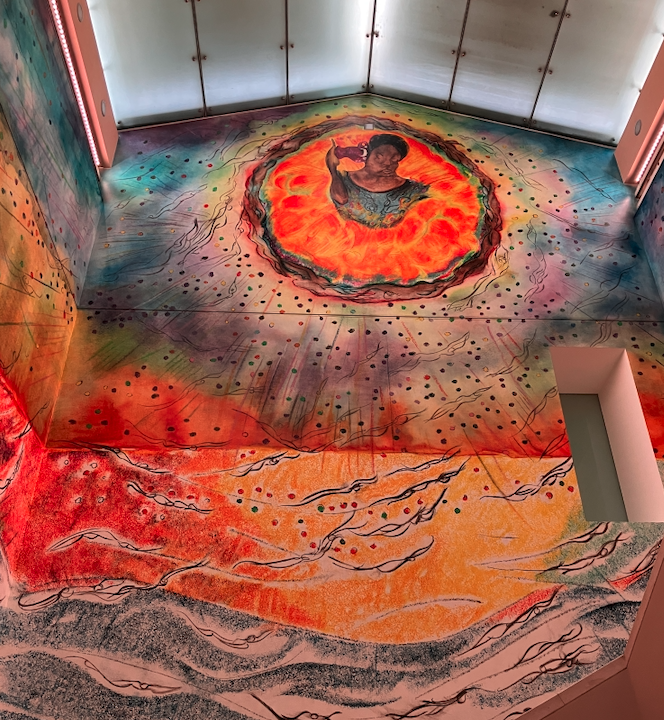
“In Requiem, there are references to the early Italian Renaissance and to classical myth, to the Babylon of Rastafarian belief, to unseen dimensions and to a kind of paradise. The rising waters in Requiem can be read both as an ocean of tears, and as the waters of Venice – where Ofili met the young Gambian British artist Khadija Saye for the first and last time in 2017, shortly before she and her mother died in the Grenfell Tower fire.” Adrian Searle in The Guardian, Wed 13 Sep 2023
Searle is right. I went to see the mural soon after reading Searle’s review and was not disappointed. I was a bit surprised, though, when I visited it again this year, and it shocked and astounded me all over again. In fact, I saw it twice this year, and each time it resonated with me as if it were the first time. The terror of the fire, the deep sadness at the loss of life and the glorious apotheosis of Khadija Saye (seen in the circle at the far wall of the mural), who is genuinely a martyr (she was killed by what can only be described as socio-political corruption). They were friends: Ofili met Saye in May 2017 at the Venice Biennale, where the 24-year-old Gambian-British photographer was exhibiting her wet-plate collodion series Dwelling: in this space we breathe. Saye died in the Grenfell fire just one month later.
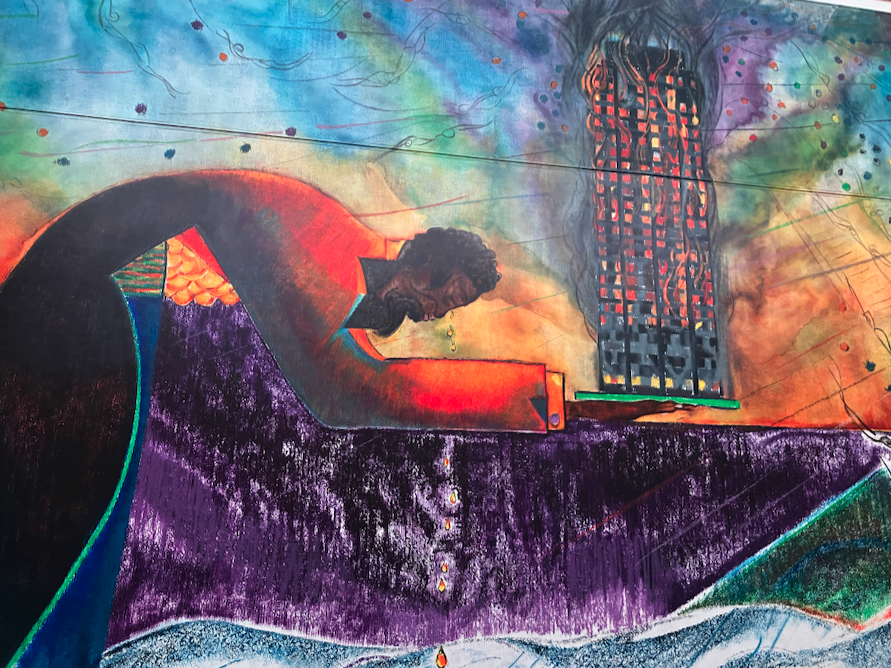
“Requiem occupies a transitory space, and also presents the transition between life and death, grief and acceptance, mourning and anger. Grenfell Tower is rendered as a kind of burning cage, its gridded windows lit by flames. Swathes of smoke and fire wreathe the tower like a conflagration in a brazier, held out, as if on a tray, by a man who bows deeply, like a master of ceremonies or a frock-coated conjurer.”
– Adrian Searle
The mural—Ofili’s first site-specific wall painting—was commissioned by Tate for a ten-year display, from 2023 to 2033. It should be preserved in perpetuity, or at least until we can be certain that an atrocity like the Grenfell Tower fire can never happen again. That will require serious legislation, meaningful accountability, and prosecutions that reach those responsible. At the current rate, the painting may need to remain there for at least another century.
*The Grenfell fire was a dreadful, avoidable tragedy in 2017 when a huge 24-storey tower block in North Kensington caught fire. The blaze was fatally compounded by poor-quality, cheap, flammable materials used by the Council and their subcontractors to ‘improve’ the old tower block. It went up like a haystack. 70 people died at the scene, and 2 people died later in hospital. Many people were injured, and 223 people escaped. The public inquiry’s final report in September 2024 concluded that all 72 deaths were avoidable. To date, nobody has been prosecuted.

